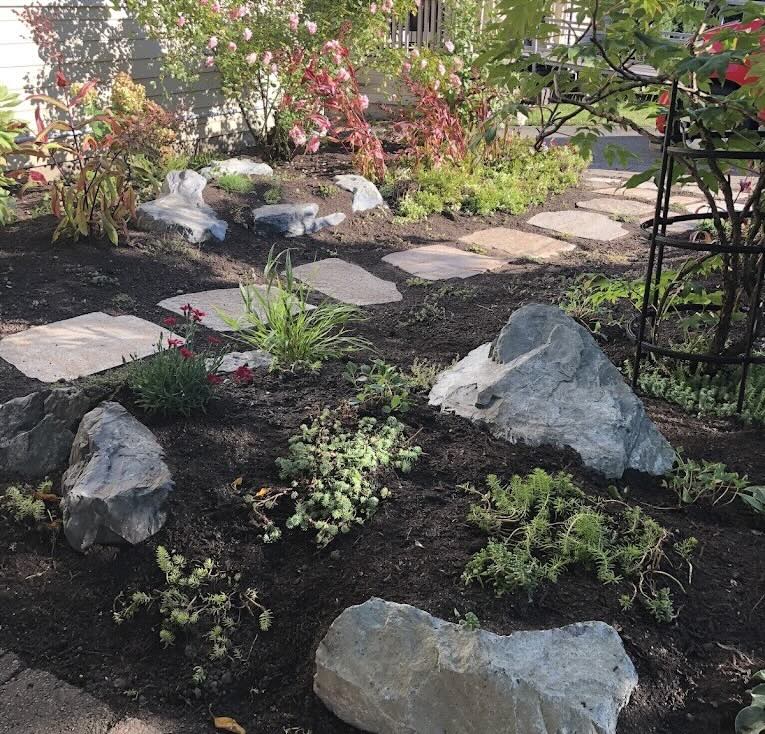
At Rutheo Designs, we use drip irrigation systems to deliver efficient, plant-focused watering solutions that align with our regenerative landscape philosophy. In Seattle’s mixed-climate conditions, where dry summers follow wet winters, drip irrigation allows us to conserve water, reduce runoff, and support healthy root development across a wide range of planting zones—from raised vegetable beds and perennial borders to native habitat gardens. By delivering water directly to the root zone, we minimize evaporation and leaf wetness, making it easier to maintain plant health without overwatering or encouraging fungal issues. We tailor every system to site-specific factors like slope, soil type, and microclimate, ensuring the right flow rate, emitter spacing, and coverage for each unique garden environment.
Drip irrigation delivers water directly to the soil at the base of plants, drastically reducing evaporation and runoff compared to traditional spray systems. This makes it one of the most water-efficient irrigation methods available—especially important in Seattle, where water use is increasingly scrutinized during our dry summer months. Because it provides moisture exactly where plants need it, there’s no overspray onto walkways, fences, or non-vegetated areas, which improves efficiency and supports Seattle’s broader goals for sustainable water management.
In addition to minimizing waste, drip systems help align residential landscapes with regional conservation standards. The precise delivery and slow application rates not only conserve water but also prevent erosion and stormwater pollution. For homeowners who want to maintain lush gardens without excessive consumption, drip irrigation offers a scalable, responsible solution.
Slow, deep watering encourages roots to grow downward rather than remaining shallow and surface-dependent, leading to stronger, more drought-resilient plants. Drip irrigation avoids wetting plant foliage, which reduces the risk of fungal diseases common in damp environments—a particularly important benefit in the Pacific Northwest where humidity can linger.
By keeping the topsoil from becoming overly saturated, drip systems also preserve soil structure and microbial life. Beneficial fungi and bacteria thrive in balanced moisture conditions, and since the water isn’t splashed or broadcast across the surface, there’s far less disruption to mulch layers or erosion-prone areas. This low-impact approach supports long-term soil fertility and landscape stability.
Because drip irrigation systems have fewer mechanical parts than conventional sprinkler systems, they tend to require less frequent repair and calibration. Emitters and tubing stay close to the ground and aren’t vulnerable to wind drift, accidental mowing, or misalignment, making them more reliable over time. Once installed, they rarely need day-to-day management beyond seasonal checks.
These systems are also highly adaptable and easy to automate. Whether managed by a basic battery timer or an advanced smart controller, drip systems are simple to program and modify. That ease of use translates into reduced labor, fewer replacements, and long-term savings on water and maintenance.
Drip emitters come in several forms, including button-style emitters that release water at set points, inline drip tubing with built-in emitters spaced at regular intervals, and porous soaker hoses for broad, even moisture distribution. Each type is selected based on plant density, bed shape, and water needs. In vegetable gardens, we often use inline tubing with close spacing, while button emitters work better for shrubs and trees.
Flow rates vary from half a gallon to several gallons per hour, depending on what’s needed for the root zone. For sloped or uneven terrain, we recommend pressure-compensating emitters, which deliver consistent output regardless of elevation or water pressure—a key consideration in many Seattle neighborhoods with varied topography.
Filtration is essential to prevent clogging of the small orifices in emitters. We install sediment filters at the water source, particularly if the system connects to harvested rainwater or older municipal lines. These filters are easy to clean and greatly extend the lifespan of the system.
Pressure regulators are equally critical to ensure steady and appropriate flow rates. Drip systems typically require lower pressure than conventional irrigation, so we include regulators to avoid blowouts or inefficient operation. Seattle’s water pressure can vary widely by location, making these components indispensable for performance and reliability.
The infrastructure of a drip system includes mainline tubing that distributes water and smaller lines that branch out to each emitter or plant group. We use UV-resistant materials designed to handle outdoor conditions and reduce degradation over time. Connectors like tees, elbows, and couplers allow us to customize layouts to suit any bed configuration.
On sloped or irregular terrain, layout strategies must account for gravity, potential pooling, and even distribution. We secure tubing with stakes or bury it under mulch to keep lines hidden, protected, and aligned. These techniques not only improve aesthetics but also ensure durability across Seattle’s variable weather and soil conditions.
Drip irrigation is ideal for vegetable gardens, where different crops often have distinct watering needs. We design zoning systems that allow separate schedules for leafy greens, fruiting plants, and herbs. In raised beds, tubing can be pinned down or lightly buried under mulch for efficient, even coverage without compacting the soil or disrupting plant roots.
For clients using rain barrels or gravity-fed cisterns, we design low-pressure systems compatible with these sources. This maximizes water reuse and gives the garden autonomy from the municipal supply during the summer months. These installations often include quick-connect fittings and manual valves for added flexibility.
For native plant landscapes, drip systems provide consistent moisture during establishment—typically the first one to two growing seasons—and then can be dialed back as plants mature. This approach supports deeper root development without creating dependency on irrigation. Once established, many native species need little or no supplemental water.
In xeriscaped zones or low-water gardens, drip irrigation is fine-tuned to provide minimal, targeted watering that avoids stress without encouraging excess growth. We avoid over-irrigation by spacing emitters more widely and using lower flow rates that match natural rainfall patterns.
For trees and large shrubs, we install looped emitter configurations that provide wide, even coverage across the full root zone. Deep watering promotes vertical root growth and reduces susceptibility to windthrow, especially for young trees still establishing in their new environment. Shrubs and perennials are grouped into zones based on water needs and sun exposure.
As the seasons shift, we encourage adjustments to runtime and frequency—especially in early spring and fall when moisture needs decline. This kind of responsiveness helps avoid waterlogging in cooler months and supports healthier plant rhythms throughout the year.
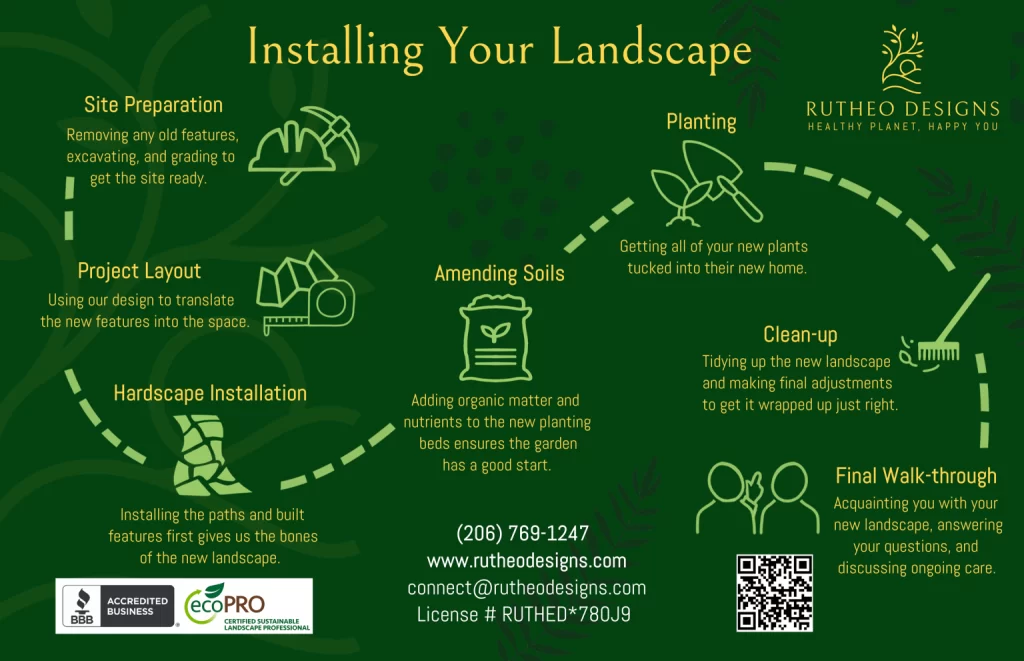
At Rutheo Designs, we are dedicated to transforming your outdoor spaces into beautiful, sustainable landscapes that reflect your vision and the unique character of the Seattle area. Whether you’re looking to enhance your garden with native plants, need expert advice on water-efficient irrigation systems, or want to discuss a comprehensive landscape design, our team is here to assist you every step of the way. We understand that every project is unique, and we take the time to listen to your needs and offer personalized solutions that align with your goals and the local environment.
Our services cover everything from initial consultation and design to full installation of hardscaping, softscaping, irrigation systems, and outdoor lighting. We ensure each element of your landscape is expertly installed and ready to thrive for years to come.
We invite you to reach out to us to start the conversation about your landscaping needs. You can contact us by email at connect@rutheodesigns.com or give us a call at (360) 844-2989. Whether you have specific questions or are ready to schedule a consultation, we’re eager to help you bring your outdoor vision to life with the care and expertise that Rutheo Designs is known for.
We use cookies to improve your experience on our site. By using our site, you consent to cookies.
Manage your cookie preferences below:
Essential cookies enable basic functions and are necessary for the proper function of the website.
Google Tag Manager simplifies the management of marketing tags on your website without code changes.
Statistics cookies collect information anonymously. This information helps us understand how visitors use our website.
Google Analytics is a powerful tool that tracks and analyzes website traffic for informed marketing decisions.
Service URL: policies.google.com (opens in a new window)
Google reCAPTCHA helps protect websites from spam and abuse by verifying user interactions through challenges.
Marketing cookies are used to follow visitors to websites. The intention is to show ads that are relevant and engaging to the individual user.
Facebook Pixel is a web analytics service that tracks and reports website traffic.
Service URL: www.facebook.com (opens in a new window)
You can find more information in our Cookie Policy and Privacy Policy.