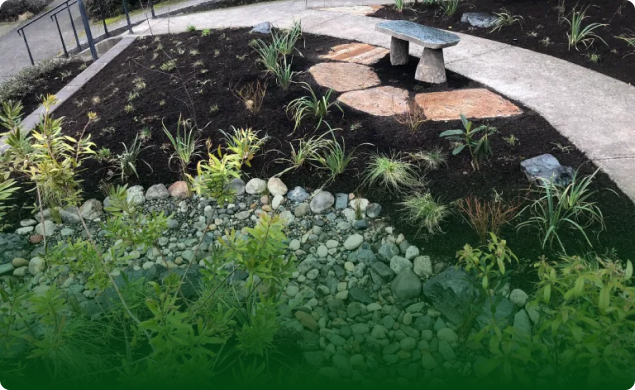

A garden layout succeeds or fails based on how it functions between October and April. In Western Washington, designing outdoor spaces exclusively around warm July weekends leads to muddy winter corridors, abandoned seating areas, and planting beds that turn into inaccessible quagmires for half the year.
A resilient layout treats your yard as an interconnected spatial system. When you balance everyday utility routes, seasonal exposure, and mature plant footprints before buying materials or plants, your landscape remains functional, low-stress, and visually engaging in every season.
Map Daily Routines Before Defining Outdoor Rooms
Before designating spaces for relaxation, trace your non-negotiable daily movement. Outdoor living areas fall apart when they conflict with practical routines like rolling compost bins to the curb, hauling firewood, walking the dog, or parking cargo bikes.
When utility routes bisect a seating area or force you to cut across wet turf in work shoes, the layout quickly deteriorates. High-frequency utilitarian routes demand direct, well-drained paths that keep you out of the mud.
Once practical circulation is established, locate outdoor rooms according to microclimates rather than simple visual symmetry:
- Low-angle winter light: A southern or western spot that feels uncomfortably hot in August might be the only place in the garden that catches warmth on a crisp February morning.
- Rain and wind patterns: Observe how wind and rain reach your property before placing a winter gathering area. An existing wall or structural overhang may offer useful shelter, depending on the site.
- Visual connection from indoors: Because Seattle homeowners spend significant time indoors during the dark months, position key focal areas—such as an architectural bench, a grouping of sculptural evergreens, or a stone water feature—along primary window sightlines from the kitchen or living room.
Exercise: The 48-Hour Movement and Use Audit
To convert raw observations into a functional spatial brief, conduct a brief self-audit over a typical wet week. Avoid the urge to draw finished boundaries right away. Instead, record real conditions over two days:
- Flag the true desire lines: Put on rain boots and take the routes you naturally use to access compost, hose bibs, storage sheds, and side gates. Mark these tracks with temporary stakes or simple survey tape. Where you cut corners across the soil, note that your layout needs a real transition there.
- Audit the wet spots and wind tunnels: Step outside during active rainfall. Note where water sheets off the roof line, where soil squishes underfoot, and where drafts channel between your home and a neighbor’s fence.
- Frame indoor viewpoints: Sit in the indoor chairs you use most often in winter. Note what you see through the glass. Identify the exact zones in the yard where a structural planting or an outdoor room element would provide year-round visual relief.
- Compile your spatial brief: On a single sheet of paper, summarize your findings into three columns: fixed utility runs, protected microclimates for seating, and zones reserved strictly for planting.
Shape Planting Beds Around Mature Layers and Maintenance Access
Planting beds are spatial boundaries, not leftover patches between paving and property lines. In the Pacific Northwest, narrow border beds against fences often fail because homeowners crowd canopy trees, shrubs, and perennials into a three-foot strip. As shrubs mature, they may outgrow their bounds, shade out lower layers, and rub against siding or fences.
Apply the principles of natural yard care right from the spatial planning stage: match bed depths to the mature spread of your plantings, build healthy living soil, and preserve root space so plants can thrive without heavy intervention. Beds with enough room for mature plants allow you to layer vegetation from front to back without crowding.
Layering for Year-Round Structure
Build your bed layout to accommodate three distinct structural tiers:
- The architectural canopy: Small deciduous trees or large evergreen shrubs that establish overhead scale and screen sightlines.
- The structural mid-tier: Woody shrubs, broadleaf evergreens, and native species that hold their form through wet, wind-swept winters when herbaceous perennials have died back to the ground.
- The living ground layer: Resilient ground covers, evergreen sedges, and hardy perennials that knit together to protect soil from winter rains and help suppress weed competition, while leaving room to assess whether additional mulch is needed.
Planning Maintenance Access Without Soil Compaction
Foot traffic can compact wet garden soil. Stepping into a soggy bed in January to prune a winter-flowering shrub or rake wet leaves can damage soil structure.
Beds that extend deep into the yard require built-in care corridors. Rather than formal paths, plan strategic maintenance stepping stones or discreet service voids that allow you to reach inner planting layers without resting your full weight on wet root zones. Keeping bed access realistic ensures you can prune, mulch, and manage plants through all seasons without damaging soil structure.
Route Paths and Hardscape Edges for Wet-Weather Reliability
A path system should carry foot traffic cleanly and confidently through relentless winter drizzle. Paths that rely on loose organic mulch or poorly retained gravel often migrate into adjacent beds or turn into spongy mud troughs by December.
Distinct hardscape edges solve this problem by creating an unambiguous separation between walking surfaces and cultivated soil. A well-planned border—whether formed by stone, metal edging, or another suitable material—can help separate the walkway from soil and mulch. Plant placement and ongoing care also matter where wet foliage could overhang a walking path.
Transitions between materials deserve careful thought:
- Keep elevation drops between patios, paths, and planting areas deliberate and visible, especially along unlit corridors used on dark winter afternoons.
- Give paths sufficient breathing room from fast-growing woody plants so you do not have to brush past water-laden foliage after a rainstorm.
- Curve paths around physical landscape anchors—like an established boulder, a structural garden bed, or an outdoor room entrance—rather than introducing arbitrary squiggles that pedestrians will naturally cut across.
Moving from Concept to Paper: Sketch, Plan, or Specialist
Once you understand your movement patterns, exposure, and bed dimensions, select the right method to finalize your spatial brief.
For straightforward, flat yards with simple circulation updates, a hand-drawn diagram showing functional bubbles may be sufficient to organize your phases. If your project involves multiple outdoor rooms, significant planting adjustments, or grading complexities, stepping up to a field sketch or scaled landscape plan gives you precise control over proportions and clearances before you commit resources to physical work.
Consider bringing in an experienced landscape designer if your site features steep slopes, severe seasonal drainage issues, or complex permitting constraints near critical areas. An outside perspective clarifies how your functional brief translates into buildable geometry that honors your home’s architecture.
If you are ready to evaluate your property’s spatial relationships and want a clear, site-responsive framework before you begin digging, explore the design and planning services at Rutheo Designs. Teddy Rutberg provides schematic concepts and site analysis to help you create an outdoor living space that thrives in every Pacific Northwest season.