Privacy planting is one of the most common requests in Seattle residential landscapes, and one of the most commonly oversimplified. Homeowners know they want to block a neighboring view, soften a fence line, or create more separation from the street. The default solution is often “plant something tall.” That instinct is understandable, but it is also why so many privacy landscapes turn into dense, overgrown maintenance projects.
Good privacy planting does more than hide. It shapes space, filters views selectively, and supports the way a yard is actually used. In a compact Seattle lot, that distinction matters. If screening is too heavy, the yard can feel darker and smaller. If it grows too fast, it creates constant pruning pressure. If it ignores moisture and spacing, the screen becomes uneven and stressed.
This guide explains how to build privacy planting that works over time, not just in the first year. For broader design context, it helps to review garden design for Seattle homes, front yard landscape design in Seattle, and small backyard design for Seattle homes before locking in a screening strategy.
Start With the Privacy Problem You Actually Have
Not every privacy issue needs full visual blockage. That is the first planning shift that prevents unnecessary screening mass.
Ask what you really need to solve:
- direct sightlines into a patio or hot tub area
- second-story overlook from a neighboring property
- street exposure at the front of the yard
- visual clutter from fencing, parked cars, or utility elements
- separation between adjacent outdoor rooms
These are different design problems. A patio that needs seated privacy may not need a thirty-foot screen. A narrow side yard may need softening more than full enclosure. A front yard may need layered filtering rather than a solid visual wall. When homeowners define privacy too generally, they often install more screening than the site can support gracefully.
This is why good privacy design usually begins with viewpoint mapping. Where are the uncomfortable sightlines? When are they most noticeable? From standing height, seated height, or inside the house? Once that is clear, the planting can be sized and placed with more precision.
Why Tall Hedges Are Not Always the Best Answer
Hedges have their place, but they are not automatically the smartest privacy solution for Seattle homes. A traditional hedge can create strong enclosure, but it also introduces ongoing clipping, width management, and light-blocking consequences that homeowners often underestimate.
The main problems with default hedge thinking are:
- mature width is ignored at install
- the screen is placed too close to fences or paths
- the species grows faster than the homeowner wants to maintain
- a single-species wall creates visual monotony and ecological thinness
- interior branches decline when light cannot penetrate the mass
On some properties, a hedge remains the right move. On many others, layered privacy planting performs better. Layering creates screening with more depth and lower visual heaviness. It also gives you flexibility. If one layer changes over time, the whole system does not fail at once.
From an ecological perspective, layered planting also supports better habitat value than a clipped monoculture wall. That makes privacy design easier to align with Rutheo’s broader ecological approach instead of treating privacy as a separate objective.
Layered Screening Usually Works Better
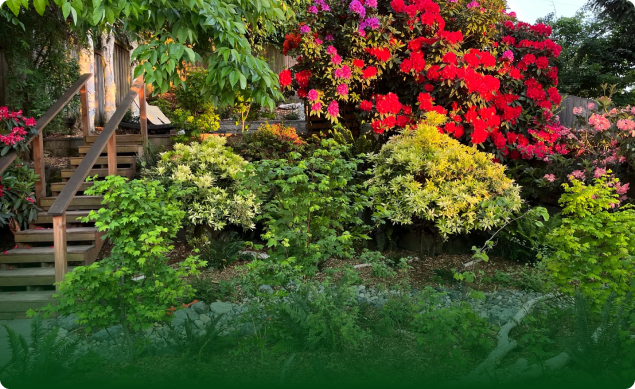
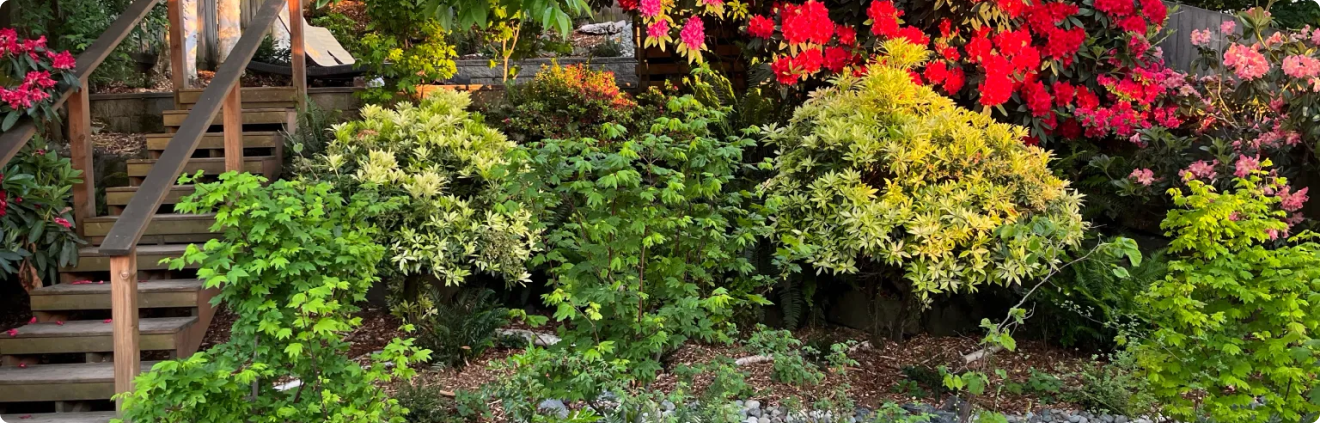
Layered privacy planting uses a combination of structure, height variation, and selective density rather than relying on one uniform screen. This often feels better in Seattle neighborhoods because it softens edges without making the yard feel sealed off.
A layered privacy composition might include:
- taller anchor shrubs or small trees for upper-level filtering
- medium shrubs to block direct sightlines at the most important height
- lower planting to ground the screen and reduce exposed fence line
- occasional open pockets to preserve light and avoid a solid-wall effect
- evergreen and deciduous balance for year-round function
The exact mix depends on whether the privacy need is front-yard, backyard, side-yard, or boundary-related. For example, front-yard privacy usually benefits from softer filtering and greater visual openness, while backyard lounging zones may need stronger enclosure at seated height.
This is where landscape design matters more than simply choosing “privacy plants.” The same species can work well or poorly depending on spacing, layering, and relationship to circulation. If you are trying to create screen value without making the yard feel cramped, the composition matters as much as the plants themselves.
Choose Plants for Mature Behavior, Not Just Initial Height
Many privacy problems start with a plant that seems perfect in the nursery and becomes completely wrong at maturity. Fast growth is often appealing when a homeowner wants screening quickly, but speed is not the same thing as long-term fit.
The better question is: how will this plant behave in five to ten years?
Evaluate:
- mature height and width
- branching density at the privacy-critical height
- pruning tolerance and response
- seasonal leaf retention
- compatibility with your light, soil, and moisture conditions
In Seattle, it is especially important to think about year-round performance. Some clients want privacy all twelve months. Others are fine with partial winter openness. That choice affects whether evergreen structure needs to carry the screen or whether deciduous layering can play a bigger role.
Maintenance tolerance matters just as much. A plant that technically screens well but needs aggressive annual control is usually the wrong choice for homeowners seeking lower-input landscapes. Privacy should reduce stress, not create a new recurring problem.
Do Not Ignore Light, Root Space, and Access
Privacy planting often fails because it is placed in the narrow leftover strip of the yard and expected to perform perfectly forever. That ignores three hard realities: plants need root volume, adjacent spaces still need light, and people still need access.
Before installing screening, look closely at:
- how much sun the screen zone receives across seasons
- whether root competition from existing trees will affect establishment
- how close the planting is to fences, structures, or paving
- whether access is needed behind or within the screen for maintenance
- how the screen affects air flow and moisture retention
These site constraints can change the right solution entirely. A narrow side-yard strip may do better with selective vertical elements and simpler planting. A broader back boundary may support layered screening with more ecological value. A wetter area may need a very different plant palette than a dry sunny edge.
This is also where screening intersects with drainage planning. If the boundary area already suffers from wet-season saturation, stuffing it with dense privacy planting may worsen disease pressure or root stress. Start with site behavior, then screen design.
Privacy Planting Should Support the Whole Yard, Not Fight It
The best privacy landscapes do not read like emergency barriers. They feel integrated with the rest of the property. Screening should reinforce outdoor rooms, circulation, and planting character instead of cutting against them.
Privacy planting works best when it:
- strengthens the boundary of a gathering space
- frames a view instead of blocking everything equally
- creates a more sheltered microclimate where appropriate
- connects visually to nearby bed structure and material choices
- balances seclusion with enough openness to keep the yard inviting
That balance matters especially in smaller Seattle lots. Over-screening can make a modest yard feel boxed in. Well-placed filtering, on the other hand, can make the same space feel calmer and more private without shrinking it.
If your project also involves redesigning how the yard is used, it helps to look at privacy in the context of full-site planning. Garden design for Seattle homes is a better companion when the screening question is part of a larger redesign rather than an isolated border fix.
When Professional Help Is Worth It
Privacy planting looks simple from a distance, but it can be expensive to correct once it is installed badly. Professional guidance becomes especially useful when you are balancing screening with light preservation, drainage, property lines, and long-term maintenance.
That is often the case when:
- the yard is small and every foot matters
- multiple neighbors create conflicting sightlines
- you want privacy without a conventional hedge look
- drainage or slope affects the screen zone
- the screen needs to look polished from both house and street
In those cases, garden coaching or an on-site consultation can help map where privacy is actually needed and what type of planting will age well in that space.
FAQ
What is better for privacy: a hedge or layered planting?
It depends on the site, but layered planting is often more flexible and lower-risk. It can create effective screening with better ecological value and less visual heaviness than a single-species hedge.
How close can privacy plants go to a fence?
That depends on mature width and maintenance access. Many privacy screens are planted too close, which makes pruning difficult and causes long-term crowding. Plan for mature behavior, not nursery size.
Can privacy planting still allow light into the yard?
Yes. Selective screening and layered compositions can block the most important sightlines without turning the whole yard into a dense wall of foliage.
Is fast-growing screening a good idea?
Only if the mature size, maintenance needs, and site conditions still fit the property. Fast growth is often appealing up front, but it becomes a liability when the screen quickly outgrows its space.
What should I do if my current privacy hedge already feels too big?
Do not automatically replace it with another single heavy screen. Step back and assess what level of privacy is actually needed, where, and at what height. A redesigned layered solution may perform better with less upkeep.
If you want privacy planting that feels calm and intentional instead of overgrown and reactive, schedule a consultation with Rutheo Designs. We can help you choose screening strategies that fit your sightlines, your maintenance tolerance, and the ecological character of your Seattle landscape.