A well-conceived landscape plan solves functional problems on paper long before equipment breaks ground. In Seattle, where urban yards endure months of soggy, low-light winter conditions followed by dry summer periods, an ecology-first design is a practical strategy to keep a yard healthy. Designing with site realities reduces expensive inputs, protects local watersheds, and keeps weekend yard chores manageable.
Lower-maintenance does not mean zero maintenance. It means eliminating tasks that fight natural systems—like shearing ill-suited hedges, constantly irrigating water-hungry exotics, or spraying chemicals to prop up struggling plants.
When you review a landscape proposal or sketch out your own property changes, evaluate the plan against these seven core principles.
1. Inventory and Protect Existing Site Assets
The most sustainable plant or hardscape feature is almost always the one already thriving on your property. Wholesale clearing strips away decades of accumulated soil biology and canopy value that take years and significant money to recreate.
Before drawing new patios or planting beds, map out what should stay:
- Mature canopy trees: Established Douglas firs, bigleaf maples, or mature fruit trees moderate urban heat, intercept heavy winter rains, and anchor the local microclimate. A good design establishes clear root protection zones (RPZs) during construction so grading equipment does not compact soil or sever anchor roots.
- Intact native soils: Undisturbed pockets of soil retain complex fungal networks and microbial life that imported topsoil blends cannot instantly replace.
- Existing rock, concrete, and grade: Salvaging existing terrace walls, weathered stone, or broken concrete slabs cuts hauling fees and keeps heavy material out of landfills.
Tradeoff to consider: Clearing a site to bare dirt allows an installer to grade quickly with a skid-steer, which can lower short-term labor costs on demolition day. Preserving existing trees and grades requires hand digging and careful equipment staging, but it preserves irreplaceable shade, privacy, and soil stability.
Plan-review question: Which existing trees, structural materials, and undisturbed soil zones are explicitly marked for preservation, and what physical barriers will protect them during construction?
2. Restore Living Soil Rather Than Replacing It
Seattle soils are notoriously variable. A property’s soil may be compacted, slow to drain, or quick to dry; those conditions need to be observed rather than inferred from its neighborhood.
Rather than hauling your native soil away to import generic “three-way mix,” a sustainable design focuses on biological restoration. Assess compaction and drainage before deciding whether soil work or compost is appropriate. A suitable organic mulch can moderate soil temperature, retain moisture, and support soil organisms.
This living foundation directly mirrors the core tenets of natural yard care: feed the soil from the top down, follow Rutheo’s exclusion of synthetic treatments, and let organic matter drive plant vigor.
Tradeoff to consider: Adding fertilizer without an identified need does not resolve every soil problem. Compare proposed organic inputs and soil work with the actual site, planting needs, and ongoing care they will require.
Plan-review question: How does the plan address subsoil compaction and drainage before planting, and what organic mulching regime is specified to feed the soil over time?
3. Match Plants to Seattle’s Wet-Winter, Dry-Summer Reality
The Pacific Northwest climate features a sharp seasonal contradiction: heavy, persistent precipitation from October through April, followed by intense drought from late June through September. Plants imported from climates with regular summer rainfall struggle here without constant supplemental irrigation.
Site-fit planting requires grouping species into distinct hydrozones:
| Hydrozone | Site Characteristics | Typical Plant Strategy |
|---|---|---|
| Zone 1: Moisture-tolerant / Riparian | Areas confirmed to experience prolonged or seasonal moisture | Choose species verified for the actual moisture, light, and summer conditions. |
| Zone 2: Moderate / Transition | Beds with moderate moisture and a recorded range of light | Match the planting community to that exposure and available care. |
| Zone 3: Drought-adapted / Upland | Drier locations, with exposed sun assessed separately from dry shade | Select for both moisture and light; a dry-shade plant is not automatically suited to exposed sun. |
By clustering plants with identical moisture and light requirements, you avoid overwatering drought-tolerant species or desiccating moisture-loving ones.
Plan-review question: Are plants grouped logically by moisture and exposure needs, and will the species selected for dry zones survive August dry spells without ongoing high-volume irrigation?
4. Layer Polycultures for Habitat and Function
A large bed filled with a single species can concentrate vulnerability to a pest or disease that affects that plant. A suitable mix can spread that risk while adding habitat and seasonal interest.
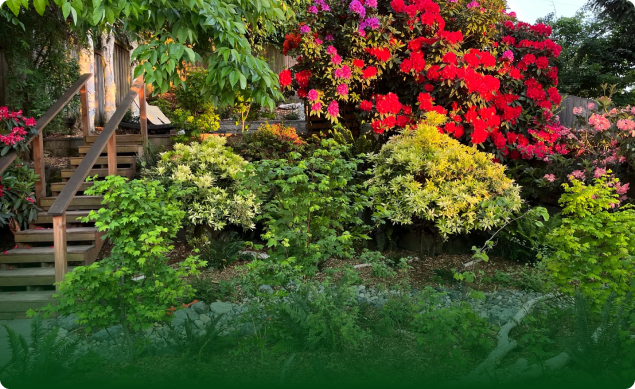
The Rutheo sustainability approach prioritizes layered polycultures that combine native species, food-producing plants, and durable structural ornamentals. Emulating natural woodland edges builds resilience:
- Canopy and Understory: Small native trees like vine maples or serviceberries provide shade, fruit, and structural shelter for songbirds.
- Shrub Layer: Evergreen huckleberries and Oregon grape can provide persistent structure, while currants add seasonal foliage, flowers, and fruit.
- Herbaceous and Groundcover Layer: Dense plantings of wild ginger, woodland strawberries, and spreading sedges act as “living green mulch.”
As groundcovers fill in, they knit together to physically shade the soil surface, cooling root zones and choking out weed seeds before they germinate.
Tradeoff to consider: Simple planting layouts can be easier to install and maintain uniformly. Mixed plantings require thoughtful placement and selective care as they establish. Their later weeding and mulching needs depend on plant growth, site conditions, and stewardship.
Plan-review question: Does the layout rely on bare mulch between isolated shrubs, or does it incorporate dense, layered groundcovers that will mature into a weed-suppressing living matrix?
5. Infiltrate Stormwater Where It Lands
Runoff from hard roofs, driveways, and steep grades puts heavy pressure on Seattle’s combined sewer systems and washes road pollutants into Puget Sound and Lake Washington. A sustainable plan treats rainwater as an on-site resource rather than waste to be piped away.
Evaluate how water moves across the site:
- Slow it down: Ask whether slowing runoff is feasible without increasing risks to slopes, buildings, trees, or neighboring properties.
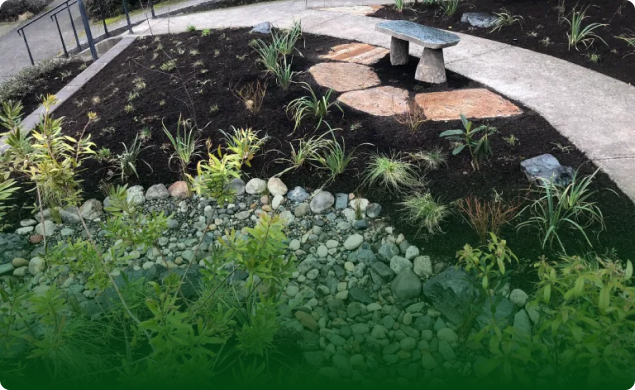
- Spread it out: Assess whether a rain garden or another appropriate system can receive runoff, including a safe overflow arrangement, before changing downspout connections.
- Sink it in: Minimize solid, impermeable paving. Where paths or patios are needed, compare permeable systems with other surfaces in light of soils, access, construction, and maintenance.
For irrigation, compare systems and zones with the planting’s actual needs. Check for evaporation, overspray, leaks, and maintenance demands rather than assuming one system suits every area.
Plan-review question: Where does roof and hardscape runoff travel during a severe winter storm, and what safe management and overflow arrangements suit this site?
6. Select Salvaged, Regional, and Low-Impact Materials
Hardscape choices define a yard’s carbon footprint and determine its maintenance demands over ten to twenty years. Cheap, synthetic, or poorly suited materials degrade quickly in our damp, moss-friendly maritime environment.
Focus on materials with proven longevity and low extraction impacts:
- Urbanite: Cracked, salvaged concrete slabs from sidewalk or driveway demolition can be stacked to form dry-stack retaining walls or laid as stepping stones. Ask what can be reused safely and how transport, preparation, and new material needs compare.
- Regional stone: Compare the specific stone or paver’s suitability, durability, source, and care requirements rather than assuming local origin guarantees performance.
- Untreated, rot-resistant lumber: When building raised beds, fences, or benches, select durable regional species like Western red cedar or juniper. Check the selected product’s intended use and suitability near edible planting zones.
Tradeoff to consider: Pressure-treated lumber and manufactured composite decking can be cheaper upfront than sustainably sourced local cedar or dry-laid stone. Ask how each specific product can be repaired, reused, or disposed of, and whether its treatment and intended use suit the proposed location.
Plan-review question: What is the life expectancy of the proposed hardscape materials in a damp Pacific Northwest climate, and where are those materials sourced?
7. Connect the Design to Real-World Stewardship
A design that demands ten hours of weekly maintenance is a bad design for a homeowner with only two hours to spare. Lower maintenance is achieved by aligning the yard’s physical demands with the steward’s actual schedule, physical capacity, and interest.
The connection between initial design and planning and long-term maintenance and stewardship should be explicit on the plan:
- Pruning style: Does the plan call for fast-growing shrubs that demand formal shearing three times a summer, or natural-form species that only need occasional deadwood removal in late winter?
- Weed prevention: Instead of planning for synthetic pre-emergent or non-selective chemical herbicides—which damage soil ecology and runoff into local waterways—does the plan use dense groundcovers, physical edging, and seasonal wood chip top-dressing to suppress weeds?
- Lawn management: If turf is included, is it restricted to functional play areas where it gets regular sun, or is it squeezed into dark, moss-prone strips where turf may remain difficult to sustain?
- Organic health care: Pest and disease issues should be addressed through species selection, airflow spacing, and cultural sanitation rather than blanket chemical applications.
Plan-review question: What specific maintenance tasks will this landscape require in April, July, and October, and do we have the time or help required to perform them?
A Plan-Review Checklist for Seattle Homeowners
When your designer or contractor hands you a conceptual plan, take twenty minutes to walk the property with the drawing in hand. Use this checklist to spot ecological design gaps before signing off:
- [ ] Canopy protection: Are existing tree driplines mapped and marked off-limits to heavy machinery?
- [ ] Soil strategy: Does the assessment establish what soil preparation or amendments are needed before planting?
- [ ] Hydrozoning: Are water-loving plants physically separated from drought-adapted species?
- [ ] Weed suppression: Is there a realistic strategy for groundcover establishment and ongoing care of open mulch beds?
- [ ] Stormwater routing: Have runoff management, feasibility, and safe overflow been assessed before selecting swales, basins, or infiltration plantings?
- [ ] Hardscape durability: Are pathways and patios built using permeable bases and regional or salvaged materials suited to damp winters?
- [ ] Non-toxic maintenance: Can the proposed planting survive and stay orderly without synthetic fertilizers, chemical herbicides, or constant shearing?
Taking time to vet these details helps you choose a landscape suited to your site, ecological goals, and available seasonal care.
If you are planning a landscape refresh and want a second set of eyes on site drainage, plant layering, or soil health, reach out to Teddy Rutberg at Rutheo Designs for a design consultation.