Designing a functional residential landscape in Seattle requires solving two contradictory weather realities: eight months of cool, saturated drizzle followed by several months of bone-dry summer drought. Properties perched on Queen Anne hillsides, tucked into Phinney Ridge lots, or spread across West Seattle slopes share this common environmental split. An idea that looks stunning in a California portfolio will rot, pool water, or wither into mud under Pacific Northwest conditions.
Before falling in love with individual materials or Pinterest layouts, evaluate every potential concept through five shortlist criteria:
- Site Fit: How does the idea handle your property’s topography, soil composition, and sun exposure?
- Daily Use: Will this space draw you outside in late October, or does it only function on clear July afternoons?
- Maintenance: Does the concept accommodate rapid spring weed surges, evergreen needles, and persistent moss without consuming your weekends?
- Cost and Phasing: Can this element stand alone initially, or does it demand extensive underground work and grading before installation?
- Dependencies: What underground utilities, stormwater pathways, or structural foundations must be resolved before this idea can exist?
Use this article as your working Seattle landscaping project guide to shortlist the concepts that match your property’s microclimate and your family’s routine. We also provide landscape design & planning services for you, to make all of this much easier.
Layout and Everyday Use
Outdoor living in western Washington hinges on shelter from continuous drizzle, managing steep changes in grade, and making intelligent use of limited urban square footage.
1. Covered Outdoor Living Pavilions
An open-sided roof structure equipped with overhead infrared heaters extends outdoor use deep into November and early March. By shedding rainfall while maintaining open sightlines into the garden, a covered structure creates an outdoor living room that avoids the damp gloom of an enclosed shed.
* Site-Fit Consideration: Check local setback lines and height limits against your home’s roofline; tall structures can inadvertently block precious southern daylight from hitting the interior main living rooms.
2. Multi-Tier Slope Terracing
Terracing steep yards into distinct, usable elevation steps converts wasted, erosion-prone slopes into stable garden rooms and seating plateaus. Rather than battling a 30-degree incline, you gain multiple functional ground levels linked by intuitive walkways.
* Site-Fit Consideration: Best suited for sloped sites requiring soil stabilization; terracing requires careful structural planning and soil assessment before moving earth.
3. Dedicated Utility and Service Corridors
Seattle city lots often force food scrap bins, recycling cans, compost tumblers, and heat pumps into plain view. Creating dedicated, screened service runs behind durable cedar slatted walls keeps working home infrastructure isolated from social gathering areas.
* Site-Fit Consideration: Demands a minimum four-to-five-foot corridor alongside the home with direct, hard-surfaced access to the street or alley.
4. Sun-Trapping Secondary Seating Pockets
Many Seattle properties feature a back patio shrouded in cool afternoon shade from neighbors’ mature Douglas firs or western redcedars. Establishing an intentional secondary terrace in the sunniest corner of the lot—often the front or side yard—gives you a warm destination during shoulder seasons.
* Site-Fit Consideration: Requires careful observation of solar angles between March and September; often thrives in unconventional, visible yard margins.
5. Productive Kitchen Gardens in Front Setbacks
When the backyard is cloaked in dense tree canopy, the front yard is frequently the only spot receiving six or more hours of direct sun. Modern raised cedar or steel beds integrated into the front approach allow for crisp vegetable production while contributing architectural structure to street-facing architecture.
* Site-Fit Consideration: Requires careful boundary framing and clean edge materials to read as an intentional garden rather than an unkempt farm plot.
6. Wet-to-Dry Mudroom Threshold Transitions
Tracking wet clay, pine needles, and soggy pet paws into the house is a constant battle during the wet winter months. A wide, all-weather transition terrace with grated scrapers, covered gear-shedding areas, and slip-resistant stone immediately outside the primary entry point keeps indoor floors clean.
* Site-Fit Consideration: Must integrate directly with high-traffic secondary entries or garage breezeways to be practically effective.
Planting and Habitat Character
Planting palettes in the Maritime Northwest must tolerate waterlogged winter roots without demanding constant supplemental summer watering once established.
7. Layered Native Woodland Understories
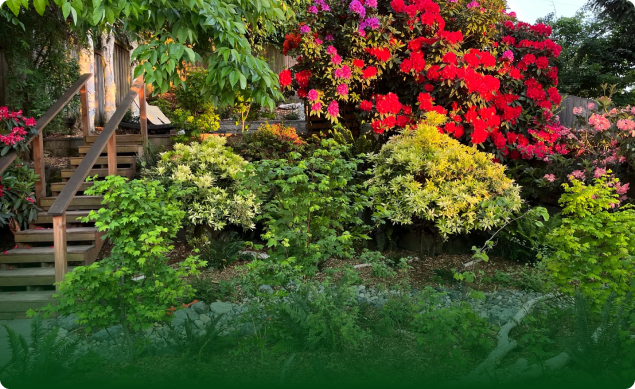
Emulating the natural tiered structure of local forests—combining vine maples with sword ferns, salal, and evergreen huckleberry—creates a resilient garden floor that thrives beneath deep evergreen canopies. This arrangement suppresses weeds naturally and handles acidic soils with zero fuss.
* Site-Fit Consideration: Ideal for north-facing yards or properties heavily shaded by established conifers with fierce root competition.
8. Gravel Garden Swathes for Summer Drought
Plantings set into deep crushed stone beds featuring drought-adapted perennials and low shrubs survive hot Seattle Augusts with minimal irrigation. By skipping organic bark mulch, you also reduce surface fungal conditions during the soaking winter.
* Site-Fit Consideration: Demands full southern or western exposure and fast-draining native soil; disastrous in heavy, unamended clay hollows.
9. Native Pollinator Boundary Buffers
Replacing conventional fence-line hedges with mixed plantings of red-flowering currant, Douglas aster, nodding onion, and oceanspray supports native bees and hummingbirds. The loose, naturalistic form offers an evolving visual buffer that shifts through the seasons.
* Site-Fit Consideration: Needs room to spread; better for perimeter runs where a slightly wild, informal aesthetic complements neighboring fences.
10. Structural Broadleaf and Conifer Winter Anchors
Seattle gardens run the risk of turning into monotone fields of brown mulch and bare twigs from November through March. Integrating bold broadleaf evergreens like Pacific wax myrtle and dwarf native conifers ensures the garden keeps its architectural skeleton year-round.
* Site-Fit Consideration: Must be positioned where their winter density provides wind sheltering or privacy screens without casting heavy shade over interior living spaces.
11. Bioretention Basins with Wet-Tolerant Native Plantings
Depressions designed to catch rain runoff from hard surfaces can be planted with water-loving species like slough sedge, red-osier dogwood, and rush. These plants slow down surges of storm water while processing surface sediments naturally.
* Site-Fit Consideration: Requires space located away from building foundations where subsoils can tolerate temporary saturation without threatening structures.
12. Architectural Evergreen Groupings for Deep Shade
Dark courtyard corners, under-eave gaps, and narrow north-facing property lines call for dynamic forms with distinct foliage. Combining bold broadleaf textures like Fatsia japonica, sweet box (Sarcococca), and delicate maidenhair ferns turns gloomy light-starved zones into lush, sculpted moments.
* Site-Fit Consideration: Only compatible with shaded, wind-protected spaces; these broad-leaved plants will scorch in direct, hot western summer sun.
13. Perimeter Espalier and Micro-Orchard Edges
Training dwarf fruit trees—such as Asian pears, hardy apples, or figs—flat against fences or standalone trellises delivers homegrown fruit without eating up valuable open lawn or patio footprint. The reflected heat from surrounding structures helps ripen fruit in cool summers.
* Site-Fit Consideration: Needs an unobstructed south- or west-facing fence run or wall that receives intense, sustained midday sunlight.
Water, Soil, and Climate Readiness
Managing surface water and building healthy, biologically active soil is the foundational engineering challenge of every Puget Sound landscape.
14. Daylighted Stone Swales for Surface Runoff
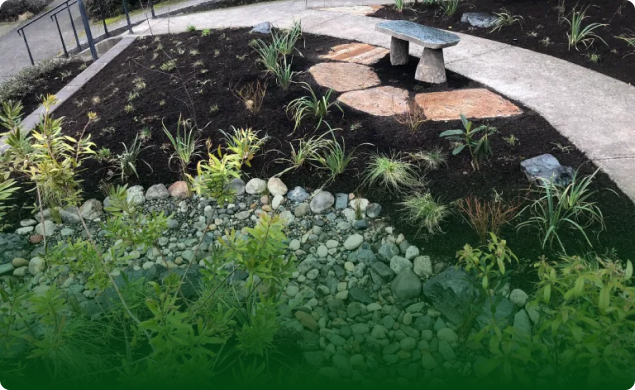
Rather than burying water lines in hidden corrugated plastic pipes that clog with hemlock needles, a shallow dry stream bed lined with local rounded river stone handles seasonal surface flow openly. During heavy storms, it becomes an active water feature; during dry months, it serves as a crisp textural path through plantings.
* Site-Fit Consideration: Works best on sites with natural grades that allow gravitational fall away from patios, driveways, and foundations.
15. Open-Joint Permeable Pavers for Driveways and Walkways
Interlocking stone pavers set over an open-graded aggregate base absorb heavy rain instantly, routing runoff straight down into the subsoil rather than overloading municipal storm drains or flooding the garage edge.
* Site-Fit Consideration: Requires stable sub-grade conditions and may not be suitable directly atop active, unstable slide-hazard zones without specialized engineering.
16. Deeply Amended Soil Sponges Over Glacial Till
Much of Seattle sits atop dense, impenetrable glacial till that acts like concrete once scraped by construction equipment. Aerating compacted subgrades and working in generous layers of coarse compost creates a functional “sponge” that holds moisture in summer and lets winter deluge drain through.
* Site-Fit Consideration: A baseline requirement for virtually every Seattle landscape installation, particularly in modern developments where topsoil was stripped away.
17. Side-Yard Cistern Catchment Networks
Slimline, modular rainwater cisterns tucked flat against north-facing side walls capture clean roof runoff during spring downpours. Storing this unchlorinated water gives you an emergency supply for sensitive landscape plants during hot, dry summer restrictions.
* Site-Fit Consideration: Requires sufficient side setback clearance and reinforced pad foundations capable of bearing immense water weight.
18. In-Ground Infiltration Dry Wells
Where yard area is tight and surface ponding is a chronic problem, underground infiltration chambers wrapped in geotextile fabric store roof runoff temporarily while it percolates away into surrounding soils.
* Site-Fit Consideration: Feasible only where soils have verified drainage permeability; completely unworkable in dense, unyielding hardpan without an overflow outlet.
19. Vegetated Windbreaks for Marine and Bluff Exposures
Homes situated along Magnolia, West Seattle, or Puget Sound ridges endure fierce, salt-laden winter storms that desiccate standard garden plants. A layered windbreak using shore pine, Sitka spruce, and tough native shrubs breaks up heavy gusts, creating a calm, protected microclimate for the rest of the yard.
* Site-Fit Consideration: Restricted to coastal and blufftop properties with sufficient planting depth to establish multiple rows of wind-deflecting material.
Hardscape, Lighting, and Detail
Persistent humidity, slick moss, and long winter darkness dictate hardscape selections that remain safe underfoot and look clean under flat gray skies.
20. Sawn or Split Regional Basalt Steps
Quarried right here in Washington, durable basalt steps offer a rich gray-charcoal tone that naturally resists spalling and moisture cracking. Their natural slip-resistant texture keeps footing secure even during midwinter freezes and perpetual rain.
* Site-Fit Consideration: Excellent for linking terraced grades, but heavy weight means they require stabilized subbases and equipment access for installation.
21. Sunken Gravel Fire Pits with Wind Deflection
A fire feature set into a gravel basin slightly lower than the surrounding lawn creates a cozy gathering pocket sheltered from cool Puget Sound evening breezes. The gravel floor drains freely and prevents the muddy tracking associated with wet lawn surrounds.
* Site-Fit Consideration: Requires adequate clearance from overhead tree canopies and property boundaries, alongside a plan for positive drainage out of the sunken base.
22. Free-Draining Crushed Rock and Mineral Terraces
Compacted mineral paths—such as crushed basalt chips or quarter-ten granite—create a clean, permeable, and affordable patio surface. They dry out rapidly after storms, inhibit moss formation compared to smooth poured concrete, and provide a crisp crunch underfoot.
* Site-Fit Consideration: Best on level or very gently sloped areas; steep slopes can suffer gravel migration during torrential downpours.
23. Mixed Cedar and Black Steel Privacy Screens
Combining tight-knot Western red cedar with powder-coated steel posts provides contemporary screening that withstands rot better than ground-contact wood posts. The dark metal complements Pacific Northwest green foliage, while the cedar introduces organic warmth to flat winter days.
* Site-Fit Consideration: Perfect for tight urban lots where dense hedges would steal too much light and planting depth from the yard.
24. Low-Profile Wildlife-Friendly Landscape Lighting
Winter in Seattle brings darkness before 4:30 PM. Installing low-glare, warm-spectrum path fixtures directed strictly downward keeps walking surfaces visible and safe without spilling light pollution into the night sky or adjacent bedroom windows. Using shielded fixtures ensures your installation functions as wildlife-friendly landscape lighting, protecting the flight paths and biological rhythms of nocturnal birds, bats, and insects that nest in the regional canopy.
* Site-Fit Consideration: Essential along main pedestrian routes, level changes, and dark step runs; requires buried conduit installed prior to final surfacing.
25. Board-Formed Concrete Retaining Benches
Cast-in-place concrete retaining walls bearing the textured wood-grain imprint of rough lumber tie modern architecture to the forested Pacific Northwest landscape. Extending the top of low walls creates built-in, rot-proof seating that stays structurally sound for decades.
* Site-Fit Consideration: High upfront impact and cost; demands clear access for formwork and concrete delivery, making it ideal for upfront master site work.
How to Shortlist Three Ideas for Your Landscape
Moving from an idea list to an active design requires narrowing your focus. Attempting to build twenty unrelated landscape features creates a chaotic, high-maintenance yard. A successful project begins with selecting three mutually compatible ideas that solve your core site problem, support your daily routines, and establish a clear palette.
Follow this practical selection process to build your design baseline:
- Solve the grade or water issue first. Look closely at how water and slope behave on your property from November through January. Pick one foundational element from Group 3 or Group 4 (such as terraced basalt steps, a stone swale, or permeable pavers) that stabilizes your ground plane and routes water safely away from living areas.
- Select your high-value living space. Identify the single outdoor activity you care most about. If you want year-round dining, choose a covered outdoor pavilion; if you want relaxed summer evenings, select a sunken gravel terrace or a sun-chasing seating pocket. Ensure this feature links directly to an existing exterior door.
- Frame the space with a cohesive planting approach. Choose one planting character that matches your shade and maintenance appetite—whether that is a resilient native woodland understory or a drought-hardy gravel garden. This single choice will define the atmosphere of the entire yard while reinforcing the site’s natural water balance.
Bringing this trio of ideas into a structured, step-by-step landscape design process ensures that grading, drainage, spatial layout, and planting work together as an integrated whole rather than competing features.
Once you have identified your top three concepts, bring your shortlist to Rutheo. We will test those ideas directly against your property’s topography, soil conditions, and solar profile during schematic planning, building an enduring landscape design tailored specifically to your home.