Natural playground design works best when the play space feels like part of the yard, not a separate plastic zone dropped onto the lawn. In Seattle, that usually means designing for mud, shade, slope, winter use, summer dry spells, and the way families move between the house, patio, planting beds, and side gate.
A good garden play area does not have to be elaborate. It might use logs for balancing, a few climbable boulders, a small digging zone, stepping stones through durable planting, and a clear place for adults to sit nearby.
The challenge is durability. Children run the same loop hundreds of times, jump from the same stone, drag sticks to the same corner, and turn any weak drainage spot into a winter mud basin. This guide explains how to plan natural playground design in Seattle yards so the space holds up physically while still supporting the broader landscape. For related context, review garden design for Seattle homes, small backyard design for Seattle homes, and Rutheo’s natural playground service page as you think through fit.
Begin with the family pattern, not the feature list
The best play spaces start with the household rhythm. A toddler who needs close supervision has different needs than older children building forts after school. A yard used for family dinners needs different circulation than a yard where play is the main outdoor destination.
Before choosing logs, boulders, or surfacing, ask:
- Which door does the family use most often?
- Does play need to stay visible from the kitchen, patio, or office?
- Should the space support one child, several children, or neighborhood play?
- Does the yard also need dining, gardening, storage, or dog access?
In compact Seattle yards, the play area often shares space with planting, paths, and outdoor rooms. If the design ignores daily movement, the feature may look charming but sit in the way.
Use logs and boulders with purpose
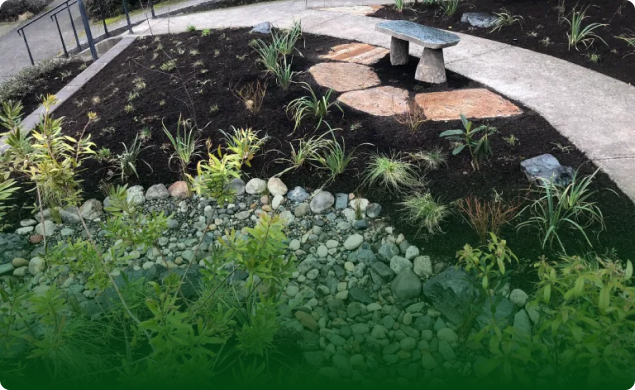
Logs and boulders are common in natural playgrounds because they invite climbing, balancing, sitting, and imaginative use. They also weather naturally and feel connected to Pacific Northwest garden character. But they need to be placed with care.
Useful roles include:
- low balance logs along a garden edge
- flat-topped boulders for sitting or stepping
- a cluster of stones that creates a small route choice
- a log border that separates digging space from planting
- a larger anchor piece that gives the play area identity
The goal is not to scatter natural objects randomly. A line of logs can define a loop. A boulder can become a stopping point beside a path. A stump group can create small-scale challenge without dominating the yard. Placement should also account for fall zones, footing, drainage, and the size of the children using the space.
Materials age differently in Seattle weather. Wood needs to be selected and placed so it does not become a slick, rotten hazard too quickly. Boulders need stable setting, not just visual placement. If a rock moves underfoot or a log rolls slightly, the natural look is no longer worth it.
Keep sightlines open without stripping the garden bare
Parents often want a play area that feels tucked into the garden but still easy to watch. That tension is real. Too much screening can make supervision difficult. Too little planting makes the play zone feel exposed and separate from the landscape.
Good sightline planning usually means keeping the center or key movement routes visible while placing taller planting along the back or sides. Low shrubs, resilient groundcovers, and open-branched small trees can create enclosure without hiding children completely. In many Seattle yards, the best play areas are partly framed rather than fully enclosed.
Pay attention to seated sightlines too. A parent sitting on a patio chair sees the yard differently than someone standing at a kitchen window. If the play space will be used while adults cook, work, or talk with guests, test those viewpoints before finalizing planting height or boulder placement.
When privacy is also a goal, privacy planting for Seattle homes can help separate the need for neighbor screening from the need for play visibility. Those two goals should not be solved with the same dense hedge by default.
Drainage decides whether the play space gets used
Seattle play areas fail quickly when water is treated as an afterthought. A low point under a swing, a compacted running loop, or a shaded corner with poor soil structure can stay wet long after the rest of the yard is usable. Children will still use it, which means the mud spreads to paths, patios, and the house.
Before building, observe the yard after rain. Look for:
- water collecting at lawn edges
- runoff from a roof, patio, or slope
- compacted soil where children already run
- mossy or slick surfaces in shade
- planting beds that drain onto the play route
The answer is not always a hidden drain. Sometimes the play zone needs a better surface, a slight grade adjustment, a gravel or wood-chip transition, or planting that tolerates occasional traffic at the edges. If runoff is more complex, French drain or rain garden? can help clarify whether water needs to move elsewhere.
Choose surfaces for repeated feet, not just softness
Natural play surfaces need to be comfortable, safe, and realistic to maintain. Lawn may work in some family yards, but it often struggles under shade, winter use, and repeated running. Mulch can work well in defined zones, but it migrates if the edge is weak. Gravel is useful for drainage and paths, but it needs the right size and depth.
Common surface choices include:
- arborist chips or play mulch for digging and landing zones
- compacted crushed rock for durable circulation
- stepping stones through planting
- reinforced soil or groundcover in lower-impact areas
- small patio or seating pads for adults nearby
The best choice depends on how the area will be used. A digging zone wants different material than a balance route. A family path to the gate needs more stability than a quiet pretend-play corner. It is often better to use two or three intentional surface types than one surface everywhere.
Edges matter here too. Play mulch needs containment. Gravel needs restraint. Planting needs protection while it establishes. A garden play area can look relaxed, but the construction details should be firm enough to handle real use.
Plant for toughness, shade, and recovery
Planting around a natural play space has a hard job. It needs to make the area feel like a garden, tolerate occasional trampling, stay non-fussy, and recover from seasonal wear. It also has to avoid obvious hazards such as thorns near running routes, brittle stems at play height, or plants that resent disturbance.
Durable planting near play areas often includes:
- sturdy shrubs placed outside the main running line
- resilient groundcovers where foot traffic is light
- shade-tolerant plants under existing trees
- pollinator plants away from the highest-speed play zones
- edible or sensory plants where picking is welcome
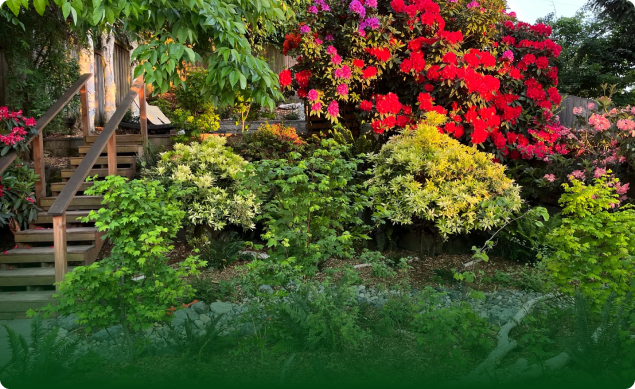
This is where ecological design can stay practical. A play yard does not need to be stripped down to turf and equipment. It can still support birds, insects, soil cover, seasonal flowers, and edible moments if the planting is placed honestly. Pollinator garden design in Seattle and native plant landscaping in Seattle can help without turning the play area into fragile planting.
Shade should be planned, not accidental
Seattle families often think about shade only during hot summer afternoons, but shade affects the play space all year. Deep shade can keep surfaces damp and slick in winter. No shade can make a south-facing play corner uncomfortable during summer dry spells. Existing trees may create wonderful canopy but also root competition and uneven ground.
Plan shade by asking:
- Is the hottest area also the most desirable play area?
- Are existing tree roots limiting excavation?
- Will a small tree eventually shade the right place?
- Does the adult seating area need shade too?
Sometimes a small canopy tree, vine structure, or carefully placed seating zone makes the whole play area more usable. Sometimes the better answer is to keep active play out from under dense evergreen shade and use that area for quieter discovery, logs, or a sitting nook.
Design for change as children grow
A natural playground should not become obsolete after two years. The best family yards allow the play space to evolve without rebuilding everything. A toddler digging corner might later become a planting bed. A balance-log route might become a garden edge.
Flexible choices include:
- boulders that also work as seating
- paths that remain useful after play needs change
- planting beds that can expand into former play zones
- logs placed where removal or replacement is possible
- adult seating that continues to serve the yard
When professional design support is worth it
Professional help becomes valuable when play, drainage, planting, and layout all overlap. That is common in Seattle yards, especially on small lots, shaded properties, or sloped sites. A designer can help locate play, choose durable materials, protect planting zones, and keep the yard from turning into a muddy loop.
Design support is especially useful when:
- the play area must share space with a patio or edible garden
- the yard has drainage problems after winter storms
- existing trees create roots, shade, or slope constraints
- you want natural features but need them set securely
- the play space needs to work for more than one age group
For early guidance, garden coaching can help you test ideas before construction. For site-specific layout questions, an on-site consultation is often the better fit.
FAQ
What makes a playground “natural”?
A natural playground uses landscape elements such as logs, boulders, landform, planting, loose parts, and garden paths instead of relying only on standard equipment. The best versions still need careful layout and construction.
Can a small Seattle yard support a natural play area?
Yes, if the design is disciplined. Small yards often work best with a simple loop, one or two durable play features, and planting that frames the space without crowding it.
Are logs safe in a wet climate?
They can be, but species, placement, stability, and surface condition matter. Logs should not roll, wobble, or become the main walking surface in a spot that stays slick all winter.
How do I keep a natural play area from becoming muddy?
Start with drainage, compaction, and surfacing. Repeated foot traffic needs a durable route or landing zone, especially in shaded Seattle yards where lawn and bare soil recover slowly.
If you want a play space that feels durable, imaginative, and still rooted in the garden, schedule a consultation with Rutheo Designs. We can help shape a natural playground that fits your family, your sightlines, and the ecological character of your Seattle yard.