Seattle homeowners often know they have a runoff problem long before they know what kind of solution they actually need. Water crosses a walkway, collects beside a foundation, keeps a lawn edge saturated, or turns a planting bed into a muddy low point every winter. The next step is usually searching for a “French drain” or a “rain garden,” but those two options solve different problems and perform very differently depending on site conditions.
That matters because a drainage feature should be chosen for the type of water behavior you have, not because it is the most familiar term. A French drain is not automatically the right answer just because there is too much water. A rain garden is not automatically the better ecological choice just because it sounds more natural. Each can be useful, and each can fail when it is asked to do the wrong job.
For Seattle properties, the right runoff strategy usually starts with site reading: where the water comes from, where it moves, where it concentrates, and what constraints the yard creates. If you need a broader framing first, pair this with soil preparation for Seattle planting projects, rain garden design in Seattle, and slope planting and erosion control for Seattle hillsides before deciding which route fits your property.
Start with the runoff pattern, not the product name
The first mistake most homeowners make is shopping for a drainage solution before describing the water behavior clearly. “The yard holds water” is not specific enough. A useful diagnosis asks:
- Is the water moving across the surface or collecting in place?
- Is the problem near the house, a walkway, a patio, or a planting bed?
- Is runoff coming from a roof downspout, slope, compacted soil, or several combined sources?
- Is the goal to move water away quickly, slow it down, infiltrate it, or all three?
Those questions matter because French drains and rain gardens are built around different goals. A French drain is generally a conveyance and collection strategy. A rain garden is generally a capture, infiltration, and ecological planting strategy. Some projects can use both, but they should not be treated as interchangeable.
When a French drain is usually the better fit
A French drain is often the right tool when the main problem is concentrated water that needs controlled collection and redirection. That might include:
- persistent saturation along a foundation-adjacent zone
- runoff crossing a path or hardscape edge
- a narrow side yard that traps water but does not have room for a planted basin
- subsurface moisture issues created by grade and compaction
In those cases, a French drain can help intercept and redirect water before it keeps damaging the same area. It is especially useful where the site needs a discreet solution or where the yard does not have the space or shape to support a planted infiltration feature.
But a French drain is not magic. It still depends on grade, outlet logic, installation quality, and an accurate reading of where the water is coming from. If those pieces are wrong, the drain may collect less than expected or simply shift the problem somewhere else.
When a rain garden makes more sense
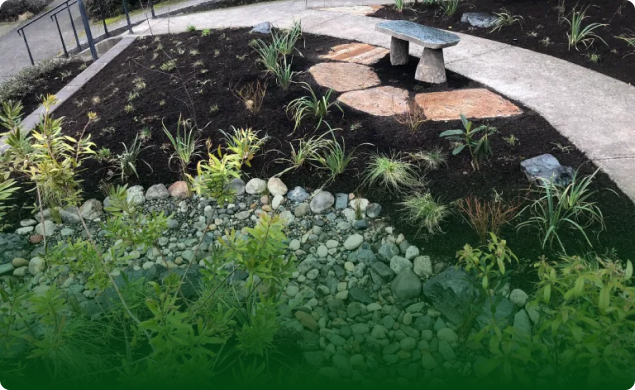
A rain garden usually works best when the goal is to slow, spread, and infiltrate runoff in a way that also improves planting value and ecological performance. This can be a strong approach when:
- runoff is coming from a downspout or broad roof area
- the site has enough room for a shaped basin and planting zone
- the yard would benefit from a more visible landscape feature instead of a hidden drain line
- the homeowner wants stormwater function and habitat support working together
Well-designed rain gardens can be beautiful and highly functional in Seattle conditions, but they are not just planted low spots. They need to be located, graded, and planted intentionally. If the infiltration conditions are poor, if the basin is undersized, or if the runoff volume is misunderstood, the result may be a soggy problem area instead of a stormwater asset.
This is why rain gardens work best as design elements, not improvised “let’s plant something where it is wet” decisions.
The key difference: move water versus hold and infiltrate water
The most useful comparison is simple. A French drain is usually chosen to collect and move water. A rain garden is usually chosen to receive, slow, and infiltrate water.
That difference has several practical implications:
- If you need the water gone quickly from a specific edge, a French drain may be more appropriate.
- If you have space to manage runoff within the landscape and want ecological benefit, a rain garden may be stronger.
- If the site has multiple runoff behaviors, the solution may involve both systems working together.
For example, a property might use a drain to intercept a narrow trouble zone near hardscape while directing other roof runoff into a planted rain-garden basin farther from the house. The right answer is often less about choosing a favorite method and more about assigning each method to the problem it actually solves well.
Site constraints often decide the answer
Even when both options sound appealing, the site usually narrows the decision. Important constraints include:
- available width and depth for excavation
- distance from structures and utilities
- existing slope
- soil infiltration behavior
- whether there is a safe and legal outlet path for collected water
- how visible or invisible the homeowner wants the solution to be
Compact Seattle lots often have enough runoff to justify intervention but not enough flexible space for every drainage strategy. That is why site-specific design matters. A rain garden needs adequate space and the right placement. A French drain needs a clear logic for collection and discharge. Neither system improves anything if it is simply squeezed into the first available strip.
Maintenance and long-term expectations matter too
Homeowners sometimes assume a French drain is maintenance-free because it is mostly hidden, or that a rain garden is high-maintenance because it is planted. Neither assumption is reliable.
A French drain may need periodic inspection if sediment, roots, or outlet issues affect performance. A rain garden requires plant establishment, seasonal care, and occasional sediment attention, especially in its early years. The better question is not which system has “no maintenance.” It is which system creates the kind of maintenance you are actually willing to support.
For many households, a thoughtfully designed rain garden becomes an attractive landscape asset once established. For others, a more discreet conveyance system is the better fit because the problem zone is too constrained or too functional to become a planted basin. The right answer should align with the homeowner’s priorities as much as with the water pattern.
Common mistakes with both approaches
The biggest problems usually come from misdiagnosis rather than bad intentions.
Common French-drain mistakes include:
- installing it without confirming where the water is entering
- assuming a drain can compensate for poor grade planning everywhere
- failing to resolve the discharge path well
Common rain-garden mistakes include:
- placing it where standing water near structures creates risk
- underestimating runoff volume
- treating it like a decorative bed instead of an engineered planting basin
Another common mistake is trying to solve every runoff symptom with one device. Some sites need layered stormwater thinking. Downspout routing, grading tweaks, planting changes, and one well-placed drainage system may outperform a single oversized intervention.
When to get professional drainage design input
Drainage work is worth slowing down for because the wrong solution often hides the real issue temporarily rather than fixing it. Design input is especially useful when:
- runoff is affecting foundations, paths, or hardscape
- multiple wet zones appear across the property
- you want a rain garden but are unsure about siting and infiltration
- you suspect the problem involves both grade and compaction
- you want ecological function without guessing where to place it
In those cases, on-site consultation or garden coaching can help establish the right order of operations. The goal is not just to install a drain or basin. It is to understand how the whole site wants to handle water.
FAQ
Is a French drain better than a rain garden in Seattle?
Not inherently. It depends on whether the site needs water conveyed away, infiltrated on-site, or both. The runoff pattern determines the answer.
Can a rain garden solve standing water beside my house?
Usually that is not the first place to put one. Water problems close to structures often need a different approach, especially if the goal is to protect the building edge.
Can I use both a French drain and a rain garden?
Yes. Many sites benefit from a combined strategy where one system intercepts or routes water and the other manages runoff more ecologically in a safer part of the yard.
Are rain gardens messy-looking?
Not when they are designed intentionally. A rain garden can look structured and polished while still functioning as a stormwater feature.
What is the best first step if I am not sure which problem I actually have?
Start with a site assessment. Understanding water movement is more important than choosing a drainage product name early.
If you are deciding between a French drain and a rain garden for a Seattle property, schedule a consultation with Rutheo Designs. We can help you read the site correctly, choose the right runoff strategy, and integrate the solution into a landscape that still looks intentional.