Slope planting and erosion control in Seattle often gets reduced to a plant-selection question. Homeowners ask what to plant on a steep bank, a sliding edge, or a difficult hillside, hoping the right species list will stabilize the problem. Plants do matter, but on slopes they are rarely the whole answer. Water movement, access, grade geometry, soil condition, and maintenance practicality often matter more.
That is why many slope projects fail even when the planting list looks reasonable. The plants were asked to solve a drainage problem, an access problem, or a grading problem they were never going to solve alone.
This guide explains how to think about hillside planting in a way that is more durable and more realistic for Seattle properties. If you are looking at a slope as part of a broader yard rethink, review garden design for Seattle homes, rain garden design in Seattle, and French drain or rain garden? alongside this erosion-control-focused article.
Why Slopes Fail Even When the Plants Are “Correct”
Most failing slopes are suffering from a systems problem. The planting may be inadequate, but it is often reacting to deeper forces:
- runoff concentrating at the top of the bank
- soil slumping or washing because grade transitions are unmanaged
- sparse root systems caused by shallow or compacted soil
- foot traffic or maintenance access disturbing the slope repeatedly
- plant choices that do not match exposure or moisture swings
Seattle hillsides can be especially tricky because winter rain exposes every weak point in the system. A slope that looks stable in August can reveal washouts, exposed roots, and muddy channels by late fall. By then, homeowners are often looking for a plant-based fix to a problem that really began with water.
This is why design matters more than plant shopping. Before choosing species, you need to understand how the slope is functioning and where it is failing.
Read the Slope Before You Plan the Planting
Every successful slope strategy starts with observation. You need to know whether the slope problem is primarily about erosion, access difficulty, plant stress, or some combination of all three.
Assess:
- where water enters the slope
- whether runoff sheets evenly or concentrates into channels
- where soil is bare, thin, or collapsing
- how much sun, wind, and reflected heat the slope receives
- whether the slope needs maintenance access now and in the future
This step often changes the entire design direction. A slope receiving concentrated roof or hardscape runoff may need water interception and redirection before planting. A slope with constant foot traffic may need stabilized access routes. A heavily shaded bank may need a very different root-structure strategy than a hot exposed one.
If you are unsure how water is moving, French drain or rain garden? and rain garden design in Seattle are often the best companion reads before finalizing the planting plan. Without that, even a thoughtful planting plan can become expensive guesswork.
Erosion Control Starts With Water, Not Just Vegetation
Plants help stabilize slopes over time, but they do not instantly stop erosion on their own. Water control almost always comes first.
That may involve:
- slowing runoff before it reaches the slope
- redirecting concentrated flows into safer routes
- reshaping transitions at the top or base of the bank
- improving infiltration where appropriate
- preventing bare soil from staying exposed during establishment
This is why erosion control should be treated as site infrastructure as much as planting design. A slope planted beautifully into uncontrolled runoff is still a high-risk slope. In contrast, a well-managed water path can dramatically improve the success of even relatively simple planting.
On some properties, this becomes a hybrid strategy that combines stormwater planning with ecological planting. If runoff and site drainage are major factors, Rainwise installation guidance may be part of the broader solution.
What Good Slope Planting Usually Looks Like
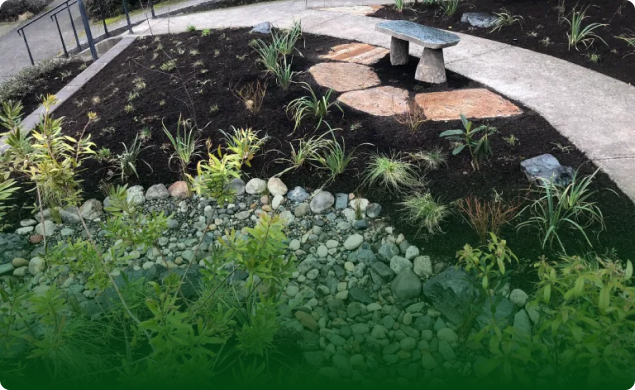
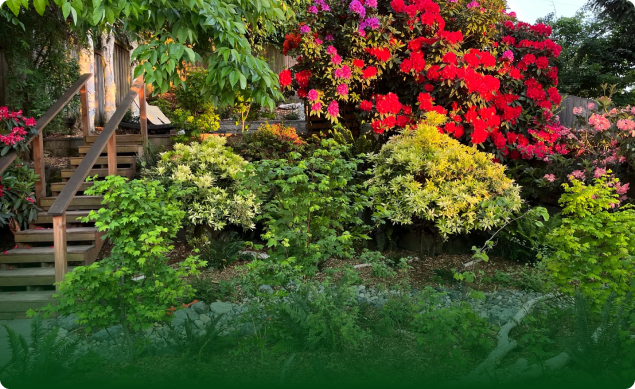
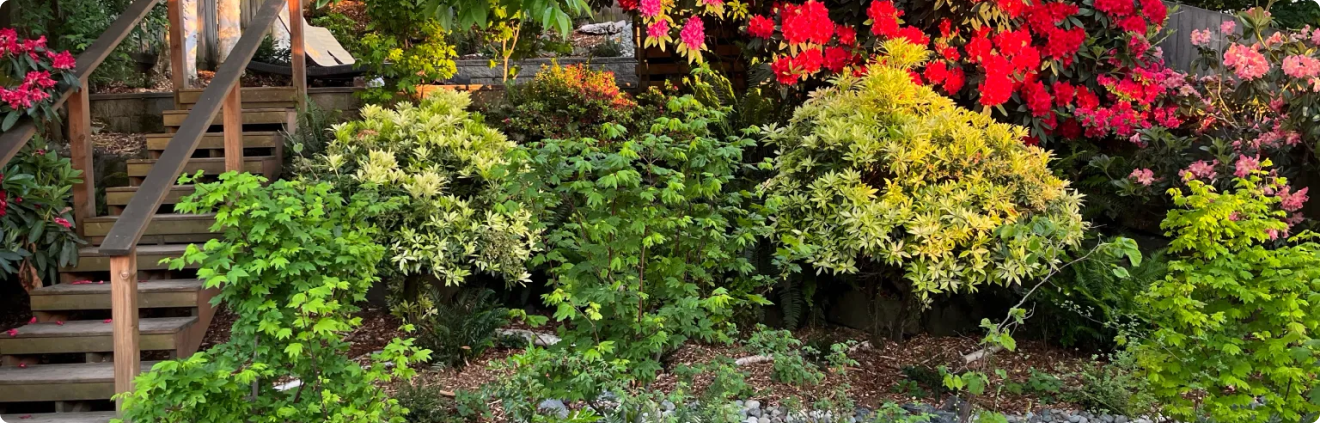
A strong slope planting plan is usually layered, rooted, and restrained. It should cover soil effectively, resist washout, and remain maintainable once established.
Effective slope planting often includes:
- deeper-rooting structural plants for long-term stability
- medium-scale shrubs that knit the slope together visually and physically
- spreading ground-layer plants that reduce exposed soil
- repeated masses rather than scattered individual plants
- species matched to both moisture pattern and sun exposure
The design should also account for mature spacing. Overcrowding a slope can be just as problematic as underplanting it because dense mass can block access, trap debris, and make maintenance difficult. The goal is stable coverage with readable structure, not a wall of anonymous foliage.
This is one reason slope design and ecological design align so well. A healthy slope is rarely built from isolated decorative specimens. It performs best as a plant community with complementary roles.
Access and Maintenance Matter More Than Most People Expect
Homeowners often think about slope planting only in terms of installation. The harder question is what happens later. Can the slope be observed, weeded, pruned, or repaired safely? If the answer is no, the design may create long-term maintenance risk even if it looks fine at first.
Important maintenance questions include:
- Is there a safe path or reach strategy for stewardship?
- Can irrigation be adjusted or repaired without destabilizing the slope?
- Will plants outgrow the available access zone?
- How will leaves, mulch, or debris behave during wet months?
- Can the lower edge be kept clean without constant disturbance?
These practical questions often separate durable slope landscapes from short-lived ones. On a hillside, the easiest-maintained design is not always the one with the fewest plants. Sometimes more complete soil coverage and stronger structural repetition actually reduce future intervention.
That is also why choosing low-drama plants matters. A slope does not benefit from high-maintenance species that need frequent shaping or replacement.
When the Slope Needs More Than Planting
Some Seattle hillsides can be improved primarily through planting and water management. Others need more substantial structural thinking. Signs that the slope may need more than planting include:
- recurring washouts after moderate storms
- active soil movement or slumping
- exposed roots or undermined edges near paths or structures
- concentrated runoff from roofs, driveways, or neighboring grades
- lack of any realistic maintenance access
At that point, planting should still be part of the plan, but it should not be expected to do all the work. Design coordination becomes much more important. You may need grading changes, drainage strategy, access planning, or a larger hillside stabilization approach before vegetation can perform reliably.
This is where a professional site-specific review can save significant rework. The wrong fix on a slope tends to fail visibly and repeatedly.
When Professional Design Is Worth It
Slope and erosion work has a narrower margin for error than many flat-yard planting projects. Professional help is especially valuable when water, grade, and usability all intersect.
That usually includes:
- slopes above or below active-use spaces
- banks carrying runoff from hardscape or roof areas
- front-yard hillsides with curb-appeal pressure
- steep sites where access is already difficult
- properties where past erosion repairs have not held
An on-site consultation can help identify whether the slope problem is primarily hydrological, planting-related, structural, or all three. That clarity matters before you commit to a plant list or installation budget.
FAQ
What is the most important part of slope erosion control?
Usually it is understanding and managing water movement. Planting is important, but uncontrolled runoff will undermine many otherwise reasonable planting plans.
Can groundcovers alone stabilize a slope?
Sometimes on gentle, low-risk slopes, but often not on their own. Many hillsides need layered planting and better water handling rather than a single groundcover solution.
Should I mulch a slope?
Mulch can help, but it needs to be used thoughtfully. On some slopes, loose mulch can migrate if runoff is not controlled. The right approach depends on grade, water behavior, and planting stage.
Is a steep Seattle slope always a professional project?
Not always, but the steeper and more hydrologically active the site is, the more valuable professional assessment becomes. Slopes are less forgiving than flat planting beds.
What is the first step if my hillside keeps washing out?
Start by tracing where the water is coming from and how it moves across the slope. That diagnosis should happen before new plants are selected.
If your Seattle hillside needs erosion control that goes beyond a hopeful plant list, schedule a consultation with Rutheo Designs. We can help you assess water behavior, planting structure, and slope-specific design priorities so the landscape stabilizes in a way that actually lasts.