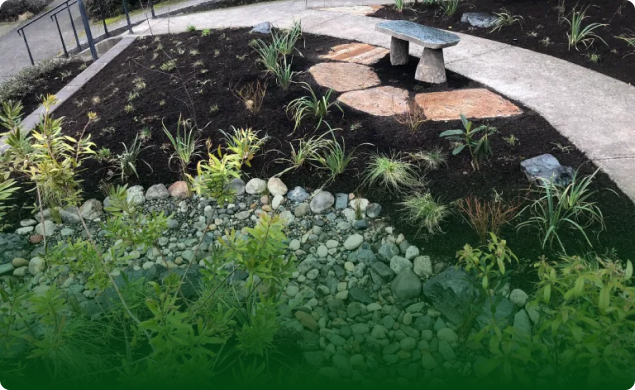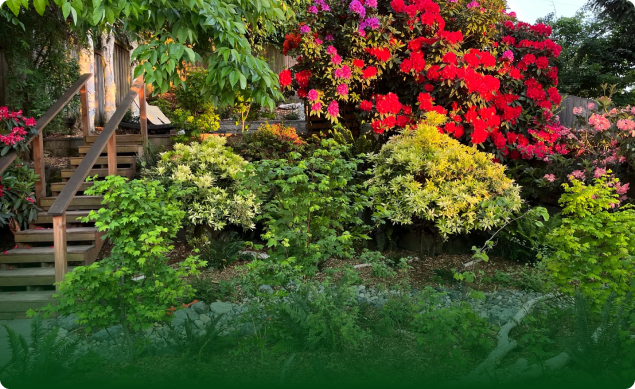
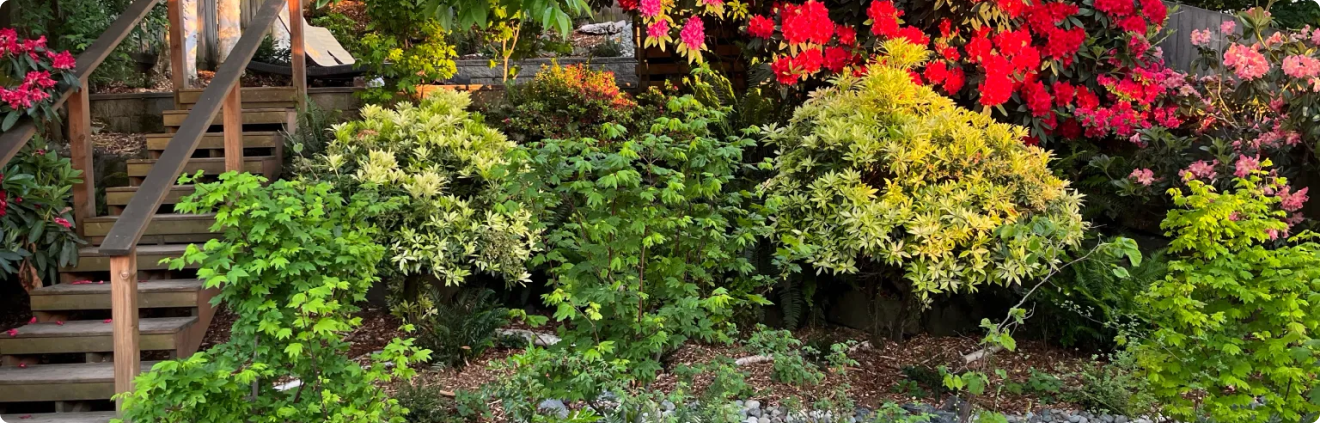
Before ordering bulk material or loading bags into a trunk, step out and look closely at the soil surface in your established beds. Many Seattle homeowners treat seasonal dressing as an automatic habit, applying whatever dark material is readily available every spring or fall.
Applying materials without understanding their function often creates more work than it saves.
A planted bed is a functioning system where roots, fallen plant matter, and surface moisture interact continuously. Deciding between compost, wood mulch, retained leaves, or simply leaving the ground alone starts with identifying the specific job you need that surface layer to accomplish.
Clarifying the Roles: Compost, Mulch, and Leaf Litter
The words compost and mulch are frequently used as if they were interchangeable. They are not. Each material serves a distinct functional purpose once it contacts the ground.
Compost Feeds the Soil Profile
Compost consists of fully decomposed organic matter. It is biologically active, fine-textured, and made of broken-down organic material. When placed on the soil surface, compost can become part of the organic matter that soil life encounters.
Compost is not an armor. Because it is fine-textured, airborne weed seeds can find a receptive surface in it. If your primary goal is to limit weed establishment, compost alone may not answer that surface-level question.
Its real strength lies in conditioning the upper layer of soil from the top down. Over weeks and months, soil life works those decomposed particles downward into the mineral soil below, gradually improving moisture retention and soil structure without mechanical disruption.
Mulch Shields the Soil Surface
Mulch is any coarse, non-decomposed or partially decomposed material applied to the ground to act as a physical buffer. In Pacific Northwest landscapes, this usually means arborist wood chips, shredded bark, or coarse wood grindings.
Mulch can function as physical protection. It can buffer bare mineral soil from rain impact and can help moderate surface moisture and temperature through dry weather.
Because wood chips are coarse and irregular, weed seeds that land on top may have a different surface in which to establish. Effective weed prevention and mulching for Seattle gardens depends on matching the material’s texture to your actual goal rather than treating any one material as a guaranteed solution.
Retained Leaf Litter Mimics the Forest Floor
Fallen leaves are the garden’s native surface material. In natural Pacific Northwest woodlands, trees continuously cycle nutrients back to their own roots through dropped foliage, creating a dynamic duff layer that feeds soil life and protects the earth.
In home gardens, retained leaf litter may suit established shrub borders, native plantings, and woodland gardens. Leaves cost nothing and break down gradually. However, leaves behave differently depending on the species.
Broad, fibrous leaves—such as those from native bigleaf maples—can form dense, soggy mats in our wet winters if left in thick blankets over small plants. Finer leaves, such as those from vine maples, birches, or dogwoods, crumble easily and incorporate into the duff layer without creating an impenetrable wet barrier. Leaf litter is ideal where you want a natural aesthetic and free soil protection, provided it does not overwhelm lower-growing understory plants.
Leaving the Surface Untouched
There are times when the best surface decision is to add nothing at all. If your planting bed is already fully covered by a dense, mature carpet of evergreen groundcovers, sprawling perennials, or low-growing native shrubs, adding mulch or compost may interfere with that established cover.
A continuous plant canopy shades the soil surface, suppresses weed germination, breaks rain impact, and cools the earth naturally. Forcing wood chips or heavy compost into a thick stand of wild ginger, kinnikinnick, or established epimediums only buries plant crowns and disrupts a stable community.
Top Dressing Versus Soil Incorporation
How you introduce material to an existing bed is just as consequential as the material you select. In annual vegetable patches, gardeners regularly till or dig organic matter directly into the planting zone. In established perennial beds, shrub borders, and beneath mature trees, digging can disturb established roots.
Many woody ornamentals, evergreen shrubs, and herbaceous perennials have active feeder roots near the upper soil horizon. These fine root structures need both moisture and oxygen to function.
Taking a spade, fork, or tiller to an established bed to blend in compost can sever roots and disrupt the existing planting.
Top dressing respects existing root architecture. When you apply material as a top dressing, you lay it across the surface and let gravity, precipitation, and soil organisms carry out the mixing process naturally. Earthworms surface to pull organic fragments downward. Fungal hyphae thread through the material, stabilizing soil aggregates. Rain gently washes dissolved organic compounds into the root zone without a single blade contacting a live root.
Top dressing requires patience. It works steadily over seasons rather than delivering an instant physical transformation of the soil profile, but it keeps the established root system intact and undisturbed.
Evaluating the Bed: What Does the Ground Actually Need?
To choose the right approach, assess the existing conditions of your bed rather than following a rigid calendar routine.
-
Is the ground bare and washing out under rain? Consider whether a coarse woody mulch is appropriate for buffering the exposed surface.
-
Is the soil exposed, hard, and low in visible organic cover? Consider whether a surface compost top dressing, a protective material, or a site-specific conversation best fits the bed.
-
Is it a woodland planting with open spaces under shrubs? Retained deciduous leaves may be compatible with the planting’s existing character.
-
Is the ground completely blanketed by healthy, dense groundcover? First consider whether the living canopy already provides the cover the bed needs.
1. Surface Exposure and Weather Impact
Look at how much bare dirt is visible. Bare mineral soil exposed to maritime Pacific Northwest winters can be affected by rainfall impact and may develop a more compacted surface. In summer, that same bare ground can lose moisture to wind and sun. If erosion or surface crusting is your main concern, consider whether a coarse, stable mulch fits the bed and its existing planting.
2. Weed Competition
Determine where your weed pressure originates. If you are constantly battling opportunistic annual weeds that blow in from neighboring lots, compost may not reduce that maintenance burden on its own. Coarse wood chips can change the surface conditions, but no surface material prevents every airborne seed from establishing.
3. Existing Organic Matter and Soil Vitality
If exposed soil has little visible organic cover, compost may be one material to consider as a surface top dressing. That observation alone does not establish a soil diagnosis; where compost is used, consider whether another surface material is also appropriate for the bed’s goals and plant access.
4. Plant Density and Type
Consider what is growing in the bed:
– Woody shrubs and conifers may be compatible with coarse wood chips or natural leaf litter, depending on the site and planting.
– Herbaceous perennials and delicate woodland plants may suit lighter covers such as shredded leaves or fine leaf mold when those materials do not cover their crowns.
– Dense groundcovers may not need added material once their foliage forms a closed canopy over the soil.
Protecting Plant Crowns, Stems, and Trunks
The most common mistake when applying any surface material—whether wood mulch, rich compost, or dense leaf litter—is piling it directly against the stems of living plants.
Roots are biologically adapted to live in moist, dark, low-oxygen conditions below ground. Stems, trunks, and the crowns of herbaceous perennials are not. The outer bark and stem tissues of woody plants require air circulation to remain healthy.
When damp mulch, compost, or wet leaves are banked against the base of a shrub or tree, moisture can remain against the bark. Over time, that condition can contribute to plant-health problems.
The crown of a perennial—the vital transition point where stems emerge from the root system—is equally vulnerable. Burying crowns beneath a heavy layer of mulch or matting leaves can hold moisture where emerging stems need air circulation.
Whenever you apply surface materials:
– Keep the material pulled back from the base of woody plants. The flare where the trunk widens to meet the soil should always remain completely visible and exposed to the open air.
– Leave breathing room around the central crowns of perennials and ornamental grasses.
– Distribute material evenly across the open root zone between plants, tapering it down to zero thickness as you approach any living stem.
When Another Layer Is Not the Solution
Surface dressings solve surface-level problems. They regulate soil temperature, slow evaporation, shield soil structure from heavy rain, and replenish organic matter at the top of the profile. They cannot correct deep structural or site-level challenges.
If water pools on the surface for days after a rainstorm, another layer of wood chips or compost is unlikely by itself to answer the larger water question. Where an established shrub is declining or a site has persistent drainage or exposure concerns, surface material may not address the underlying condition. Similarly, surface layers cannot substitute for a planting location that does not meet a plant’s light or moisture needs.
When plants show chronic, multi-season decline, yellowing leaves, or continuous dieback despite regular watering and surface maintenance, those observations may point to questions beyond a surface-material choice.
If your garden is showing persistent drainage issues or planting concerns that go beyond choosing between mulch and compost, Rutheo Designs offers site-specific soil health and amendment services. We can help frame a site-specific soil and planting review before you make another surface-material decision.