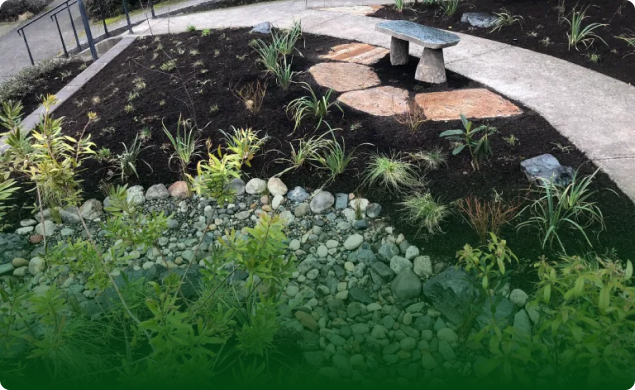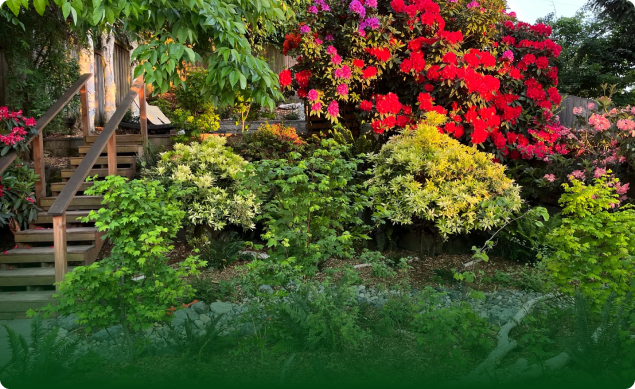

Permeable pavers, gravel, and planted strips can all work on a Seattle driveway, but they ask different things of the property and homeowner. Cars turn, brake, and unload beyond two neat wheel tracks. Rain can carry needles or soil across the surface, while the street edge sets another boundary for cleanup and construction.
At Rutheo Designs, we compare the full driveway before choosing the finish: supporting ground, vehicle movement, wet-weather water and sediment, and the upkeep the household will actually do. Pavers provide a more fixed tire surface; gravel accepts movement and occasional reshaping; planted strips work only where wheels and feet leave them alone.
The useful comparison starts with the site, not the sample board. First, mark how cars, water, and debris move across the space.
Start With the Cars, Grade, and Water Route
A parked car shows only the final position. We also watch how it gets there: where the front tires sweep during a turn, whether the driver backs in, which edge the rear tire follows, and where people step out. Repeated turning near a garage or sidewalk works the surface differently from straight parking.
On a narrow driveway that slopes toward the street beside a porch, backing in at an angle can put one rear tire close to the planting bed while the front tire crosses most of the drive. During steady rain, water from adjoining paving may follow the same low edge toward the sidewalk. A centered pair of wheel tracks would miss both the wider turning movement and the water route.
We mark those movements after rain, along with settled spots, roots, the garage threshold, and any bare soil or leaf litter beside the drive. The source matters as much as the puddle. Water crossing from a patio presents a different design question from water that appears at a low point within the driveway, and soil washing from a bed can change how an otherwise sound surface ages.
When the route remains unclear, a drainage and water-flow assessment can connect the driveway to the rest of the property. Surface comparison comes after we understand the tire paths, grade, and likely source of incoming sediment.
The Base Carries the Driveway
Once the site marks are on paper, attention moves below the finish. A driveway is an assembly: the visible material, any setting layer used by that system, the supporting base, the ground beneath it, and the edges that hold the surface in place. Water may also need a route beyond those layers. A label such as “permeable” does not settle what happens below or beside the drive.
The turning area from the porch example deserves more attention than a straight wheel path because tires keep working across it. Existing soil, roots, old settled paving, and runoff from the adjacent yard all affect how we approach the supporting work. Our hardscaping work for driveways and parking areas starts with those conditions rather than a standard package built around the chosen finish.
This is why a garden-path detail cannot simply be repeated under cars. Foot traffic and a wheelbarrow do not create the same use as daily parking and turning. If the supporting layers or edge do not suit the driveway, the surface may show rocking pavers, displaced gravel, a defined wheel depression, or water collecting where the finish has shifted. Replacing the visible material alone would miss the cause.
Pavers Give Tires a Stable Surface, but Joints Can Clog
Pavers appeal to homeowners who want defined tire paths and a surface that reads as finished hardscape. That order comes from the full system, including its joints or open cells. Water meets the driveway through those openings, so their condition belongs in everyday observation.
Douglas fir needles can settle along an uphill driveway edge while fine soil washes from an unfinished bed into joints near the turning area. At first the buildup looks cosmetic. As the joints pack with sediment, water can begin moving across a place where the owner expected it to enter the surface.
Seattle’s July 2026 stormwater maintenance guidance identifies damaged or missing paver blocks, lost material between pavers, damaged open-cell grids, and poor grass coverage as conditions that need attention. EPA guidance adds accumulated sediment, leaves, and debris to the maintenance picture. For the homeowner, the useful signs are visible: packed joints, a rocking unit, missing joint material, or water taking a new route after rain.
We address the sediment source along with the permeable paver installation. An unfinished bed above the drive can keep feeding soil into clean joints, so surface care alone will not settle the problem. Pavers can give turning tires a more orderly surface than loose material, but the openings still need to stay visible and reachable.
Gravel Works Where Migration and Rut Repair Are Acceptable
Gravel asks for a different kind of ownership. The surface can look appropriate on an informal property, and small changes do not stand out as sharply as they would in a field of pavers. Tires will still move loose material where they turn, brake, or follow the same line day after day.
Repeated turning on a single-car driveway pushes gravel toward the inside edge and makes the wheel paths easier to see through the wet months. Leaves settle in the low track, while scattered stone near the alley or street makes the driveway edge look wider even though the usable route has not changed.
That driveway may still suit an owner who accepts occasional reshaping. The relevant question is not whether gravel can remain perfectly still; it is whether the household is comfortable returning displaced material, correcting developing tracks, and keeping the border from dissolving into the adjacent bed. Edge access matters here. A tight hedge or parked trailer beside the drive can turn a small correction into an awkward job.
Pavers make movement easier to notice because a unit rocks or a joint changes. Gravel shows wear more gradually through migration and ruts. Neither observation ranks one surface above the other. For a homeowner who prefers a crisp, fixed finish, gravel may create too much recurring work. Where a changing surface suits the property and periodic repair is acceptable, it remains a reasonable driveway choice.
Planted Strips Must Match the Actual Wheel Path
A planted driveway is often drawn as two straight tire tracks with a green strip between them. Real cars are less tidy. Front and rear wheels follow different arcs, drivers correct their position, and the route changes when another car is parked nearby.
A family car may enter straight when the curb is clear but back out at an angle when someone parks across the street. A visiting work van takes a wider line, while collection bins narrow the side route and send passengers toward the middle of the drive. A planted strip based only on the parked car could sit under an angled rear-tire path and in the place people use to reach the back door.
We watch several arrivals and departures before placing planted areas. Both tire paths matter, as do door access, bicycles, bins, and the occasional larger vehicle. A strip that survives routine parking but gets crossed every time a passenger unloads groceries is not well placed, even if it looks balanced on a plan.
Vegetated open-cell paving has another layer of wear because the grid and plant cover share the vehicle surface. Seattle’s current guidance treats damaged grid and poor grass coverage as maintenance conditions. A separate planted strip does not behave exactly the same way, yet repeated tire contact and bare patches send a similar message: the planting and the household route disagree. We place living material outside repeated tire and foot traffic, where the household can reach and care for it.
Plan for Sediment, Cleanup, and the Street Edge Before Installation
Before installation, we trace what can land on the driveway and how the owner will reach the places where it collects. EPA guidance calls for controlling sediment during installation and removing accumulated soil, leaves, and debris as part of ongoing care. That brings the uphill bed, unfinished shoulder, and overhanging tree into the driveway plan.
Cleanup access can disappear where a driveway runs between a hedge and a low wall. Fine soil washes from a bed near the garage, autumn leaves gather at the lower corner, and collection bins occupy the only open edge on pickup day. The buildup remains visible from the street but unreachable along the narrow side while a car is parked. A surface that depends on access to that edge will become frustrating unless the layout changes first.
That access problem helps settle the owner decision. The selected surface should leave tire routes, sediment collection points, borders, and planted areas visible enough to care for. A polished sample matters less than knowing where the household will stand while clearing the drive, whether displaced material can be returned without entering a bed, and whether a parked car blocks the only useful access.
The street end needs the same attention. Seattle identifies the curb as public right-of-way and assigns property owners responsibilities along adjacent sidewalks and roadway edges. We record where the private driveway meets the sidewalk, curb, shoulder, or alley, then keep that boundary distinct from the material choice. It affects where debris gathers, how people cross, and which questions need to be settled with the City before construction.
Choosing among pavers, gravel, and planted strips comes down to the driveway that is actually there: its vehicle movements, supporting ground, water route, street connection, and the upkeep the owner will keep doing. At Rutheo Designs, we look for the surface and layout that agree with those conditions rather than forcing a favorite material onto the property.
A focused site walk is the next step. Watching one car enter and leave after rain often reveals more than a row of material samples ever will.