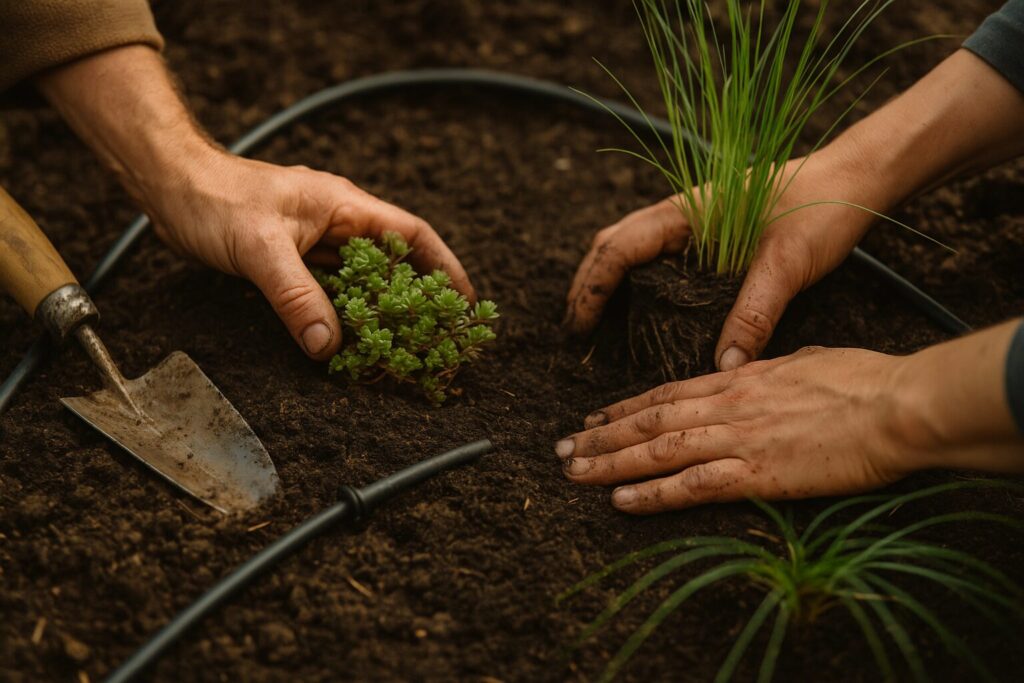
We harness the hardy charm of groundcovers and ornamental grasses to craft sustainable, low-maintenance gardens that thrive in Seattle’s unique maritime climate. By clustering moisture-wise plants such as native red fescue (Festuca rubra) and hardy sedges alongside evergreen groundcovers like kinnickinnick (Arctostaphylos uva-ursi), we create living carpets that suppress weeds, improve soil stability, and support urban biodiversity. Our selections focus on deep-rooted species that capture rainfall and reduce erosion on sloped sites, while also providing year-round texture, from the fine emerald blades of tufted fescue to the rustling seed heads of Deschampsia cespitosa. This living mulch approach not only cuts back on routine upkeep but also fosters habitat for beneficial insects and sequesters carbon in the rich, living soil layer. Our installations include bio-based weed barriers and drip-irrigation zones calibrated for each cluster, ensuring water is delivered only where it’s needed. Once established, these living systems require little more than an annual cut-back and occasional inspection, leaving you free to enjoy a lush, self-sustaining landscape without the fuss.
We prioritize grasses and groundcovers known for robust, fibrous root systems that tap into subsurface moisture reserves. Species such as blue fescue (Festuca glauca), creeping thyme (Thymus serpyllum), and sea thrift (Armeria maritima) are established performers in heat-stressed sites. Their narrow leaf blades and compact growth habit minimize water loss through transpiration, while their dense root mats guard against soil compaction. We often specify planting at densities of six to eight plants per square foot to accelerate canopy closure and shade out competing weeds.
To further bolster drought resilience, we amend planting beds with horticultural sand or grit (up to 20% by volume) to improve aeration and drainage. We also inoculate roots with arbuscular mycorrhizal fungi, creating symbiotic networks that extend water uptake zones. Drip irrigation lines are zoned and pressure-regulated to deliver precise volumes, typically 0.4 gallons per hour per emitter for the first full growing season. After establishment, supplemental watering can often be reduced to once every two to three weeks during dry spells.
Our selection process favors plants with inherent defenses against common Pacific Northwest pests. Groundcovers like golden creeping Jenny (Lysimachia nummularia ‘Aurea’) and fescues develop tough, waxy cuticles that deter slugs and snails, while aromatic compounds in thyme and oregano groundcovers repel aphids and caterpillars. Grasses such as miscanthus (‘Morning Light’) and tufted hairgrass (Deschampsia cespitosa) rely on dense clumping forms that make it difficult for leaf-chewing insects to penetrate.
In addition to choosing resilient species, we employ integrated pest management (IPM) strategies to maintain ecological balance. This includes installing pheromone traps for early detection of moth larvae and encouraging beneficial predators—lady beetles, lacewings, and predatory mites—through companion plantings of yarrow and dill. We schedule regular site inspections, especially in spring and early summer, to catch outbreaks before they spread, reducing or eliminating the need for chemical interventions.
Dense plantings of overlapping groundcovers act as a living mulch, shading the soil surface and preventing weed seedlings from gaining a foothold. We often intermix fast-spreading species like Sedum album and Saxifraga urbium at ratios of roughly 70% coverage to achieve near-complete canopy closure within six to eight weeks. This canopy intercepts up to 90% of sunlight at ground level, drastically reducing weed germination rates and the need for hand weeding.
Beneath this green layer, we install biodegradable weed barriers crafted from coconut coir or jute. These materials break down over two to three seasons, enriching the soil while supporting microbial life. We finish with a thin, two-inch layer of shredded bark or leaf mulch to retain moisture and moderate soil temperature. This dual approach minimizes soil disturbance and supports the growth of our chosen species without synthetic herbicides.
On sloped properties or areas prone to runoff, we rely on species whose root architectures provide high tensile strength and soil binding. Tufted hairgrass and deep-rooted fescues create an interlocking mesh of roots that can reduce soil displacement by up to 80% on inclines of 15–20 degrees. For more extensive embankments, we integrate creeping juniper (Juniperus horizontalis) and cotoneaster groundcovers, whose stoloniferous growth fills gaps and forms a stable mat across soil surfaces.
We also design planting patterns that follow contour lines or natural swales, slowing sheet flow and encouraging infiltration. In more severe erosion zones, we may install temporary coir logs and silt fences during establishment, removing them once the vegetation has achieved 70% soil cover. This approach balances immediate erosion control with long-term resilience, allowing vegetation to shoulder most of the stabilization work once mature.
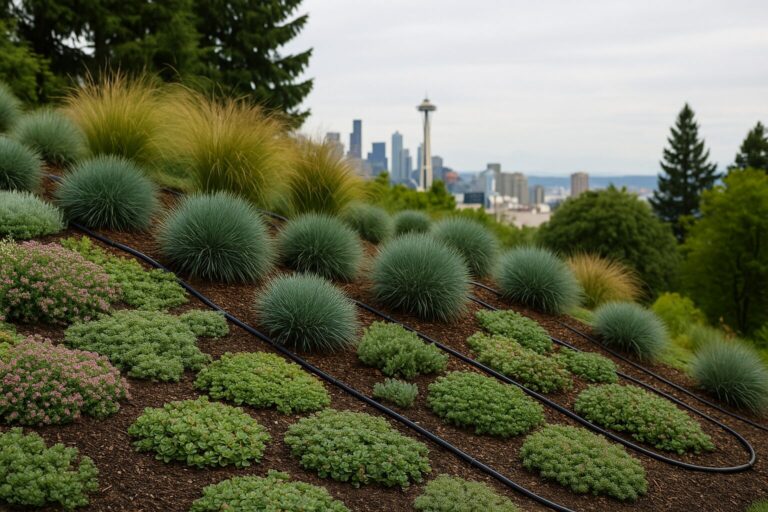
A successful low-maintenance landscape begins with a tailored soil profile. We collect composite samples from multiple areas of the site, testing for pH (ideal range 6.0–6.8), nutrient status, and organic matter content. Based on results, we incorporate composted pine bark (15–25% by volume) and rock dust to adjust texture and feed beneficial microbes. Sandy or heavily compacted soils receive additional organic matter to create a loamy, friable medium.
When laying out plant clusters, we map zones by moisture and light exposure, assigning each species to its optimal niche. Drip-irrigation manifolds are installed underground, with pressure-compensating emitters placed at each root ball location. Once plants are positioned and backfilled, we apply an initial irrigation cycle of 20–30 minutes per zone, ensuring deep saturation without runoff. Finally, a two-inch layer of wood-chip mulch is spread uniformly, taking care to keep it 2–3 inches away from plant bases to prevent crown rot.
After establishment, the primary maintenance tasks are timed to coincide with seasonal growth cycles. In late winter (February to early March), we perform a clean-up and cutback of grasses, removing last year’s dead foliage to stimulate fresh spring shoots. Groundcover beds benefit from a light hand rake that lifts dormant crowns and clears debris. We advise homeowners to monitor soil moisture by probing with a trowel before running irrigation, often only two to three infrequent sessions are needed in summer after the first year.
Every two to three years, a light top-dress of compost (no more than a quarter-inch layer) replenishes organic matter and nutrients. We also recommend an annual check of drip lines in late spring to clear any clogs and adjust emitter output based on mature plant water use. Aside from occasional trimming of invasive runners, these landscapes flourish with minimal intervention, freeing gardeners to enjoy their outdoor spaces rather than manage them.
We design each installation as an interdependent plant guild, combining groundcovers, grasses, and flowering forbs to mimic natural community dynamics. In filtered shade, we underplant native wild ginger (Asarum caudatum) beneath taller grass species, using its broad leaves to retain moisture and suppress weeds. In sunnier zones, we pair spiky blue fescue with low-growing Sedum spurium, creating textural contrast while facilitating pollinator movement.
Seasonal interest is woven into every cluster: early-spring bulbs and ephemeral natives fade out just as summer-blooming grasses unveil their plumes. We include late-season seed heads that feed birds and provide winter structure, then rotate maintenance tasks to preserve these features. This layered strategy enhances resilience, supports beneficial fauna, and ensures the landscape remains visually engaging throughout the year.
For expert guidance on incorporating groundcovers and ornamental grasses into your Seattle landscape, reach out to Rutheo Designs for a personalized consultation. We’ll evaluate your site’s soil conditions, light exposure, and drainage patterns to recommend the ideal plant palette, whether you’re aiming for dense weed suppression, enhanced erosion control on slopes, or a drought-tolerant ground layer that supports local pollinators. During our meeting, we’ll review design options, discuss installation methods (including soil amendments and irrigation strategies), and outline an easy-to-follow maintenance plan tailored to your garden’s goals.
Email us at connect@rutheodesigns.com or call (360) 844-2989 to schedule your consultation. Whether you want advice on selecting the best Festuca and Carex varieties, guidance on establishing natural mulch layers, or recommendations for drip-emitter layout, we’re here to ensure your project succeeds with minimal upkeep and maximum ecological benefit.
We use cookies to improve your experience on our site. By using our site, you consent to cookies.
Manage your cookie preferences below:
Essential cookies enable basic functions and are necessary for the proper function of the website.
Google Tag Manager simplifies the management of marketing tags on your website without code changes.
Statistics cookies collect information anonymously. This information helps us understand how visitors use our website.
Google Analytics is a powerful tool that tracks and analyzes website traffic for informed marketing decisions.
Service URL: policies.google.com (opens in a new window)
Google reCAPTCHA helps protect websites from spam and abuse by verifying user interactions through challenges.
Marketing cookies are used to follow visitors to websites. The intention is to show ads that are relevant and engaging to the individual user.
Facebook Pixel is a web analytics service that tracks and reports website traffic.
Service URL: www.facebook.com (opens in a new window)
You can find more information in our Cookie Policy and Privacy Policy.