
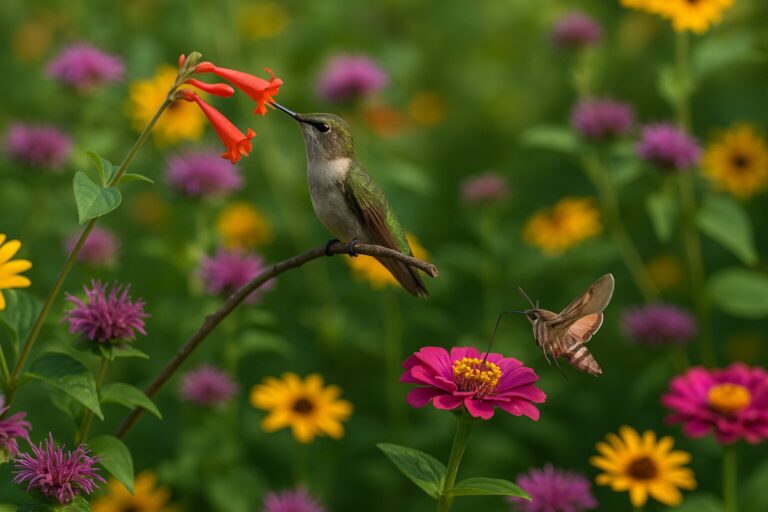
We create habitat-rich gardens that do more than just look beautiful; they support pollinator life cycles from egg to adult. Our Hummingbird & Moth Garden Services are tailored specifically for Seattle’s climate and ecology, focusing on native nectar plants, larval host species, and night-blooming perennials that welcome both diurnal and nocturnal pollinators. We plan each garden with intentional layering to provide structure, bloom succession, and protection year-round. Our team integrates flowering species, chosen for their ecological function and their ability to attract species like sphinx moths and Anna’s hummingbirds, which are common to the region. These gardens are more than ornamental; they’re living systems that respond to the shifting patterns of pollinator migration and climate resilience.
We prioritize native species because they offer the highest ecological compatibility with Seattle’s pollinators. For hummingbirds, plants with tubular, nectar-rich blooms are essential. Our core planting list includes Penstemon serrulatus (Cascade penstemon), Lonicera ciliosa (orange honeysuckle), Lobelia cardinalis (cardinal flower), and Agastache foeniculum (anise hyssop). These species offer staggered bloom times and varying heights for vertical diversity.
For moths, especially nocturnal species, we include night-scented and pale-colored flowers such as Oenothera biennis (evening primrose), Nicotiana alata (flowering tobacco), and native phlox. These flowers often open in the late afternoon or evening, releasing scent plumes that help moths locate nectar in low light conditions. Their pale coloring makes them easier for moths to visually locate at dusk.
A common mistake in pollinator gardens is bloom gaps, times when few flowers are available. We avoid this by building a timeline of continuous bloom. Early season nectar sources like Ribes sanguineum (red flowering currant) support spring emergence. Summer brings mid-season heavyweights like bee balm and yarrow, while fall-blooming asters and goldenrod ensure that pollinators can fuel up before migration or overwintering.
Our garden plans include a combination of perennials, shrubs, and trees layered intentionally to produce overlapping bloom windows. We often include understory plants like Maianthemum racemosum (false Solomon’s seal) and Solidago canadensis (Canada goldenrod), both of which offer late-season value. This extended availability of nectar supports not just adult pollinators, but also enhances reproductive success.
Supporting adult pollinators with nectar is only part of the equation. True restoration requires integrating larval host plants that allow pollinators to breed and develop within the landscape. For example, hummingbird clearwing moths lay eggs on honeysuckle and snowberry, while white-lined sphinx moth caterpillars feed on plants like willow, grape, and evening primrose.
Our garden designs embed these hosts among ornamental selections to ensure the space remains both ecologically functional and visually appealing. We educate clients on the importance of accepting small amounts of leaf damage, a sign of healthy caterpillar activity and incorporate naturalistic elements like leaf litter, hollow stems, and undisturbed ground to shelter overwintering pupae.
The physical structure of a garden directly impacts pollinator behavior. Dense, layered plantings offer shelter from wind, reduce predator visibility, and create microclimates that aid in pollinator survival. We design gardens with a vertical gradient, from low groundcovers like Fragaria vesca (woodland strawberry) to mid-layer perennials and tall flowering shrubs like Philadelphus lewisii (mock orange).
These structural zones provide more than visual depth. For hummingbirds, elevated perches offer surveillance and nesting sites, while moths benefit from leaf canopy to rest during daylight hours. In shaded gardens, we include species adapted to dappled light that still attract pollinators, such as Aquilegia formosa (western columbine), which draws both moths and hummingbirds with its long nectar spurs.
Pollinator-friendly gardens must be free of pesticides, especially systemic ones like neonicotinoids, which contaminate nectar and pollen. We guide clients to organic practices and regenerative soil management, avoiding synthetic inputs and encouraging compost use, mulching, and soil inoculants that support mycorrhizal fungi.
Artificial light at night can severely disrupt moth behavior, including navigation and mating. Our nighttime habitat strategies include shielding garden lights, using amber-tinted bulbs when necessary, and keeping high-output lighting to a minimum. Where possible, we place night-blooming plants in areas of natural shade or soft lighting to minimize disruption.
Adding a water source, such as a shallow bird bath, drip station, or misting feature, can significantly enhance hummingbird use of a garden. These features should be shaded, shallow, and cleaned regularly to avoid mosquito breeding. We often position them near key nectar sources, allowing birds to perch and preen between feedings.
Scent is another underused design tool. Moths locate flowers primarily through olfactory cues, so we create scent corridors by clustering fragrant night-bloomers together. We place these clusters near patios or windows where humans can also enjoy their perfume, adding another layer of sensory engagement to the garden.
One of the most rewarding aspects of hummingbird and moth gardens is their around-the-clock activity. While hummingbirds are most active from dawn to late afternoon, moths take over at dusk, often fluttering silently between blooms under moonlight. By pairing day-bloomers with night-bloomers, we ensure gardens remain vibrant from morning to night.
For example, bee balm and salvia may attract hummingbirds through the day, while nicotiana and night phlox open in the evening for moths. Some transitional plants, like coral honeysuckle, remain accessible across both windows, increasing plant value without requiring additional space.
Seattle’s mild winters, long daylight hours in summer, and increasing climate volatility create a complex challenge for pollinators. Warmer winters can lead to mismatched bloom timing and early emergence, while heavy rainfall in spring can limit foraging time. Thoughtfully designed gardens provide refuge and consistency within this changing matrix.
By planting regionally adapted species and reducing reliance on non-native ornamentals, our gardens become part of a broader ecological solution. As habitat corridors shrink and climate pressures mount, each hummingbird- and moth-friendly yard can serve as a stepping stone in the restoration of local biodiversity.
Whether you’re envisioning a garden alive with hovering hummingbirds or hoping to support Seattle’s nocturnal pollinators with night-blooming flowers, we can help you bring that vision to life. Our specialty coaching for Hummingbird & Moth Gardens offers tailored guidance on selecting regionally appropriate nectar plants, integrating larval host species, sequencing blooms for seasonal coverage, and creating a nighttime habitat that supports moth biodiversity. We’ll walk you through habitat planning, garden layering, and ecological maintenance strategies that invite these pollinators in and keep them coming back. Reach out to us at connect@rutheodesigns.com or call (360) 844-2989 to begin your pollinator restoration journey. Whether you’re wondering which native honeysuckle attracts sphinx moths or how to balance scent-driven night gardens with ornamental appeal, we’re here to guide you every step of the way.
We use cookies to improve your experience on our site. By using our site, you consent to cookies.
Manage your cookie preferences below:
Essential cookies enable basic functions and are necessary for the proper function of the website.
Google Tag Manager simplifies the management of marketing tags on your website without code changes.
Statistics cookies collect information anonymously. This information helps us understand how visitors use our website.
Google Analytics is a powerful tool that tracks and analyzes website traffic for informed marketing decisions.
Service URL: policies.google.com (opens in a new window)
Google reCAPTCHA helps protect websites from spam and abuse by verifying user interactions through challenges.
Marketing cookies are used to follow visitors to websites. The intention is to show ads that are relevant and engaging to the individual user.
Facebook Pixel is a web analytics service that tracks and reports website traffic.
Service URL: www.facebook.com (opens in a new window)
You can find more information in our Cookie Policy and Privacy Policy.