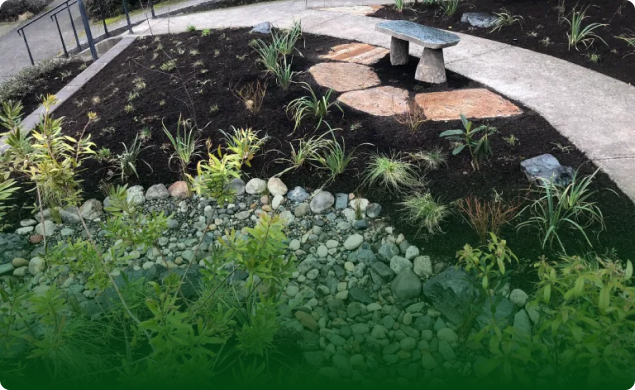

The first steady autumn storm in the Puget Sound is the most informative moment of the year for your rain garden. After months of dry summer weather, western Washington soils shrink, leaf litter collects in downspouts, and surface mulch settles. When the season’s first atmospheric river or persistent front arrives, you get a clear look at how your system handles live runoff before winter storms arrive in earnest.
A rain garden is an active bioretention system, not a static landscape bed. Taking thirty minutes before, during, and after that first storm allows you to verify that water enters, pools, and disperses exactly as intended.
The Pre-Rain Visual Check
Before the first major front makes landfall, inspect the flow path while the ground is still workable. Your goal is simply to verify that nothing physically blocks the water from entering, soaking through, or exiting the facility.
Focus on three distinct zones:
- The inlet: Look at where water discharges into the garden, whether from a downspout extension, a pop-up emitter, a dry creek bed, or a curb cut. Clear out accumulated summer lawn thatch, deciduous leaves, pine needles, and any neighborhood trash that has settled around the splash rock or pipe opening. Do not rearrange the rock protection; its job is to dissipate energy and prevent fast-moving water from carving a trench in the soil.
- The basin floor: The flat bottom of the rain garden is the primary infiltration zone. Remove heavy mats of fallen leaves that can create an impermeable organic blanket over the soil mix. Light, scattered leaves can remain to break down naturally, but dense, wet clumps will smother groundcovers and slow water absorption.
- The overflow route: Every rain garden includes an overflow point—typically a shallow rock-lined notch, an overflow pipe, or a contoured swale—designed to convey excess water safely away once the basin reaches maximum storage capacity. Ensure this spillway is completely clear of sticks, yard waste, and drifted bark so excess water cannot back up unpredictably.
This inspection is strictly about clearing blockages. Resist the urge to dig, regrade, or alter the garden’s geometry.
Watching the Garden During Active Downpours
Step outside in boots and an umbrella when rainfall is steady. Watching water actively enter the garden reveals flow dynamics that cannot be diagnosed when the weather is dry.
First, observe how runoff enters through the inlet. Water should flow across the rock apron without scouring the mulch behind it. If water shoots past the rock pad or bypasses the inlet entirely because of an upstream gutter overflow, you will see it immediately.
Next, watch the basin fill. Inflow should spread across the flat basin bottom rather than pooling in one isolated corner. A healthy bioretention bed allows water to rise gradually across the planted area, submerging plant crowns temporarily while giving the engineered soil column time to soak it up.
Finally, check the overflow point during a heavy burst. In moderate rainfall, water may never reach the overflow crest. During intense downpours, however, the basin may fill to capacity. When this happens, excess water should slip smoothly through the designated overflow path and travel toward the street, a secondary swale, or the municipal storm connection. Effective rain garden design in Seattle depends on this exact relief valve to protect home foundations and neighboring properties from localized saturation. If you notice water spilling over an unintended low spot along the garden rim, note the exact location.
Post-Storm Observations to Record
Once the rain stops, monitor how the garden clears over the following day or two. Keep a brief note on your phone or in a garden journal tracking four specific items:
- Drainage behavior: Check the basin at regular intervals. Rain gardens are engineered to drain ponded water within a reasonable window rather than acting as permanent ponds. Because drainage rates depend heavily on the storm’s volume, the saturation of the native subsoil below the garden, and ambient temperatures, there is no single universal hourly cutoff. What you want to see is a steady, noticeable drop in the water level over time.
- Water marks and debris lines: Ring lines of floating mulch, seed pods, or foam indicate the peak ponding depth. Verify that this high-water mark stayed comfortably below the top edge of your berm or basin bank.
- Sediment accumulation: Check the inlet apron for small “deltas” of fine silt, sand, or roofing grit washed off the house. Fine sediment should be scooped out before it washes into the basin interior and clogs the top layer of bioretention soil.
- Mulch displacement: Look for scour holes where bare soil was exposed by moving water, or rafts of floating wood chips piled up in low corners. Displaced mulch points directly to areas where flow velocity was higher than anticipated.
Routine Ecological Upkeep for Early Fall
Autumn provides ideal conditions for low-impact plant care and maintenance in our maritime climate.
Hand Weeding
Autumn moisture softens the ground, making it easy to remove taprooted weeds like dandelion, dock, and blackberry runners. Pull weeds by hand from the root crown rather than hoeing, which disturbs the carefully blended bioretention soil. Avoid all chemical herbicides and synthetic fertilizers; anything applied within a rain garden can leach directly into local waterways and shallow aquifers during saturation events.
Mulch Stewardship
Bioretention mulch protects the underlying soil from surface compaction caused by heavy rain droplets, keeps weed seeds from germinating, and retains moisture for root systems. Check that the basin floor has a consistent, breathable layer of coarse, arborists’ wood chips or designated bioretention mulch. Avoid fine-shredded bark mixes or dyed beauty bark, which tend to float, form water-repellent mats, and wash toward the overflow.
Plant Health and Autumn Planting
Fall is the best window for planting in the Pacific Northwest. The soil remains warm while natural rains keep roots consistently moist, allowing plants to settle in before summer drought.
Inspect your existing plant palette:
* Identify any rushes, sedges, dogwoods, or Douglas spirea that failed to survive the summer dry spell. Remove dead root balls and replace them with moisture-tolerant native species suited to their specific zone in the basin.
* If you install new container plants during an unseasonably warm or dry stretch of October, supply deep supplemental watering to help them settle into the surrounding soil. Do not assume light autumn showers are penetrating deeply into nursery root balls.
When to Seek Site-Specific Assessment
Ordinary maintenance involves clearing debris, monitoring drainage, and replacing an occasional perennial. However, certain physical observations point to hydrologic issues that simple gardening cannot resolve:
- Persistent standing water: If water remains pooled in the basin long after a storm has passed with no noticeable downward movement, the surface soil may be clogged with fine silt, or the underlying subgrade may have experienced drainage issues.
- Active bank erosion or severe rilling: Deep cuts through the side slopes, washed-out berms, or structural undermining around the inlet apron indicate that incoming water velocities exceed what the current rock protection can absorb.
- Unintended overflow paths: If water spills out over the side of the garden toward your foundation, a neighbor’s lot, a crawlspace, or an unpaved slope rather than through the engineered overflow point, the garden rim may have settled or the overflow crest may be too high.
- Upstream bypass: Water flowing around the inlet rather than into it suggests the pipe, rock weir, or diversion channel has shifted or clogged upstream.
When you notice water traveling where it shouldn’t, recurring erosion channels, or standing water that outlasts typical drainage behavior, a targeted drainage and water flow assessment can determine whether the problem requires clearing deeper blockages, adjusting spillway grades, or modifying inlet armoring.
If your autumn observations reveal concerns beyond simple leaf clearance and weeding, reach out to Rutheo Designs. We can evaluate how your rain garden functions within your broader landscape and ensure your outdoor space remains resilient through the Pacific Northwest winter.