Moving Beyond Outdoor Interior Decorating
Traditional landscape design treats a yard like an outdoor living room. The standard playbook installs turfgrass as the carpet, lines the perimeter with isolated shrubs like furniture against a wall, and uses bark mulch to hide exposed dirt. Ecological landscaping starts from a fundamentally different premise: your property is an interconnected living system where soil, water, plants, and daily use affect one another.
Across Seattle, our urban lots sit on land shaped by glaciers, maritime air, and centuries of dense coniferous forests. When we replace those relationships with high-input lawns, we inherit a constant maintenance battle against weeds, mud, moss, and summer drought. Working ecologically means stepping back from the urge to shop for decorative plants or install quick-fix drainage pipes. Instead, you design your outdoor space to function like a self-sustaining ecosystem—one that captures water, builds living soil, supports regional biodiversity, and fits your household’s daily routines.
Reading the Site: Soil, Water, and Daily Patterns
Before introducing new materials or moving earth, you must understand the invisible systems already operating across your property. Every square foot of your yard has an existing relationship with hydrology, sunlight, geology, and foot traffic.
Soil and Subsurface Conditions
Seattle soils are notoriously variable, often within the boundaries of a single residential lot. Much of the city rests on glacial till—compacted, cement-like hardpan that resists water infiltration and root growth. Other neighborhoods feature deep deposits of sandy outwash that drain instantaneously, or heavy clay seams that pool water for weeks during the winter.
Modern construction compounds these variations. When homes are built or remodeled, heavy equipment compacts the ground, subsoil gets spread over topsoil, and construction debris gets buried beneath a thin veneer of imported loam. Determining where your ground drains freely, where water ponds, and where soil life is currently suffocated provides the physical foundation for every decision that follows.
The Maritime Precipitation Cycle
Seattle’s seasonal pattern makes it important to observe both wet-season drainage and drier summer conditions.
An ecological landscape must handle both extremes without cracking under pressure. It must absorb and store winter saturation without drowning plant roots, while possessing the structural resilience to endure weeks of clear skies and dry winds without constant municipal irrigation.
Light, Microclimates, and Human Habits
Sunlight patterns shift dramatically between December and July at our northern latitude. A two-story craftsman house or a mature Western red cedar casts a long, cold shadow across an entire backyard during the winter months, only for that same corner to receive intense overhead light in midsummer.
Alongside environmental factors, human and pet use dictates where plants can survive. Where does the dog run the fence line? Which route do you walk to drag trash bins to the curb in the rain? Where do you naturally gravitate to drink morning coffee or host friends? Mapping human movement keeps you from planting delicate habitats where foot traffic will inevitably trample them.
Assembling Plant Communities Instead of Isolated Specimens
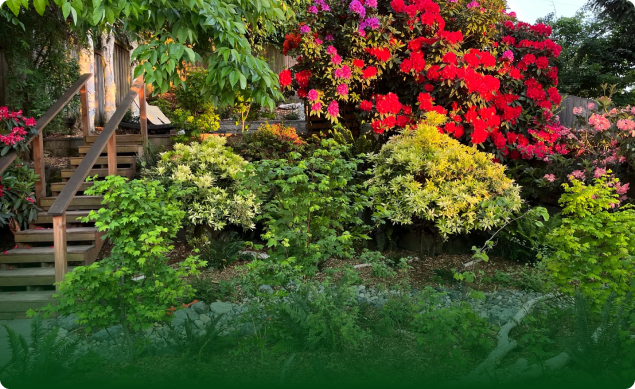
In wild Pacific Northwest landscapes, plants never grow as isolated dots spaced neatly four feet apart. They assemble into dense, collaborative communities that cover the ground, share root space, trade nutrients through fungal networks, and shelter each other from wind and sun.
Approaching native plant landscaping in Seattle requires stepping away from traditional nursery specimen shopping and thinking instead about how regional woodland understories organize themselves. Wild systems thrive by stacking functional layers:
- Canopy and Sub-Canopy: Tall conifers and deciduous trees that break the physical impact of heavy winter rains, slow evaporation in summer, and pull moisture deep into the ground.
- Shrub Layers: Mid-height woody plants that offer nesting cover, wind protection, and seasonal fruit or nectar.
- Herbaceous Ground Layer: Perennials, ferns, and grasses that lock down the surface soil, crowd out opportunistic weeds, and capture low-angle light.
- The Rhizosphere: Underground root matrices and fungal threads that weave the soil together, cycle organic matter, and create macro-pores for drainage.
Native plants can be considered in relation to site conditions and mature size. Noninvasive, climate-adapted companion plants can also play supportive roles—especially in heavily disturbed urban soils or hotter microclimates—provided they do not escape into nearby greenbelts. The goal is not an ideological collection of plant tags, but a multi-tiered community where every species performs a clear ecological and functional job.
Keeping Water and Soil Working on the Parcel
Water management is part of ecological landscaping: observe how rainfall moves across roofs, hardscape, beds, and soil, then choose site-appropriate ways to reduce avoidable runoff and protect planting conditions.
Applying sustainable landscape design principles means considering soil care and deliberate surface routing together:
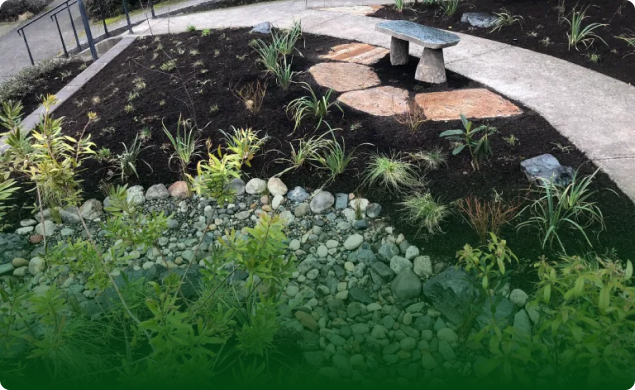
- Infiltration Over Evacuation: Directing clean roof downspouts toward gently dished infiltration basins, bioswales, or deep-rooted planting beds keeps water on-site, recharging the shallow groundwater and filtering road pollutants.
- Minimal Soil Disturbance: Tilling, deep digging, and soil stripping destroy mycorrhizal fungi, sever existing root pathways, and bring dormant weed seeds to the surface. Building soil from the top down preserves structural stability.
- Functional Mulches: Ditch synthetic landscape fabric and finely ground dyed bark, which can compact into a water-repellent crust. Coarse, uncomposted arborist wood chips allow water to pass freely, reduce evaporation during hot August stretches, and slowly break down into fungal-rich organic matter.
- Thoughtful inputs: Avoid treating fertilizer or pest response as the default solution. Consider soil and water impacts, and seek site-specific guidance when a treatment decision is needed.
Making Habitat Legible and Usable
A common misconception is that an ecological yard must look untamed, messy, or neglected. Without intentional structure, an urban garden dense with habitat features can easily look unmanaged to family members, neighbors, and municipal inspectors.
Ecological landscapes succeed in urban neighborhoods when they incorporate clear human “cues to care.” These design elements frame wilder natural processes and signal that the space is deliberate:
- Defined Edges: A crisp boundary between a stone patio, an intentional gravel walkway, or a clean mulch path gives the eye a reference point, turning a dense planting bed from an apparent thicket into a framed botanical feature.
- Functional Movement: Wide, stable walking paths invite you into the garden throughout the wet winter months without compacting the soil sponge around plant roots.
- Integrated Habitat Elements: Nurse logs, rock piles for solitary bees, and standing seed heads look striking when placed intentionally as architectural focal points rather than left as scattered debris.
By combining ecological density with thoughtful hardscapes, you create spaces that support native fauna while remaining comfortable, practical, and inviting for human living.
Stewardship as an Ongoing Conversation
Traditional landscape maintenance focuses on control: shearing hedges into unnatural geometric shapes, blowing every fallen leaf into a yard-waste bin, and spraying any volunteer seedling that appears in a bed. This approach consumes endless time and fossil fuels while running directly counter to natural processes.
Ecological landscaping replaces mechanical maintenance with adaptive stewardship. You shift your role from an enforcer to an editor. During the first two years, you focus on providing structural water support during summer droughts and pulling aggressive weed species before they set seed. As plantings mature, your tasks shift toward light editing: pruning to open sightlines, clearing paths, and redistributing fallen leaves onto bed surfaces where they act as natural winter mulch and insect habitat.
An ecological garden is not a static installation with a fixed warranty date; it is an evolving living system that grows deeper, more resilient, and easier to manage with each passing year.
Clarifying Your Next Landscape Decision
Rather than trying to overhaul your entire property in a single weekend, break your transition into manageable, targeted inquiries:
- Water and Drainage: Are you dealing with surface pooling near foundations, or are you looking to unhook downspouts and direct runoff into functional infiltration beds?
- Planting Transitions: Are you ready to convert an underperforming, high-maintenance turf area into a layered, drought-tolerant understory guild?
- Holistic Project Planning: If you are navigating major slope changes, access issues, or extensive hardscape removals, reviewing a structured Seattle landscaping project guide can help you stage heavy earthwork and soil rebuilding before you order plants.
If you have spent time observing your soil, sun, and winter water patterns but want help choosing the next question, contact Rutheo to discuss a site-specific ecological assessment.