We believe every garden should be a living system that gives back. Our beneficial insect habitat services are designed for clients who care about ecological health and want to play an active role in restoring native pollinator populations across Seattle. We integrate pollinator-friendly zones into residential and commercial landscapes by selecting layered plant communities that bloom in succession, provide overwintering sites, and support keystone species. Whether you’re revitalizing a small backyard or stewarding a large green space, we’ll help you design and install a biodiverse habitat that welcomes native bees, hoverflies, lady beetles, lacewings, and other critical insect allies. Our approach goes beyond just planting nectar-rich flowers; we build habitat corridors that consider soil health, microclimate, canopy structure, and species interdependence.
We begin with native foraging habitat, selecting regionally adapted wildflowers, shrubs, and groundcovers to supply nectar and pollen across the seasons. From early-spring native bulbs and willow catkins to summer-blooming daisies, tall grasses, and zinfandel poppies, we ensure continuity for diverse pollinators.
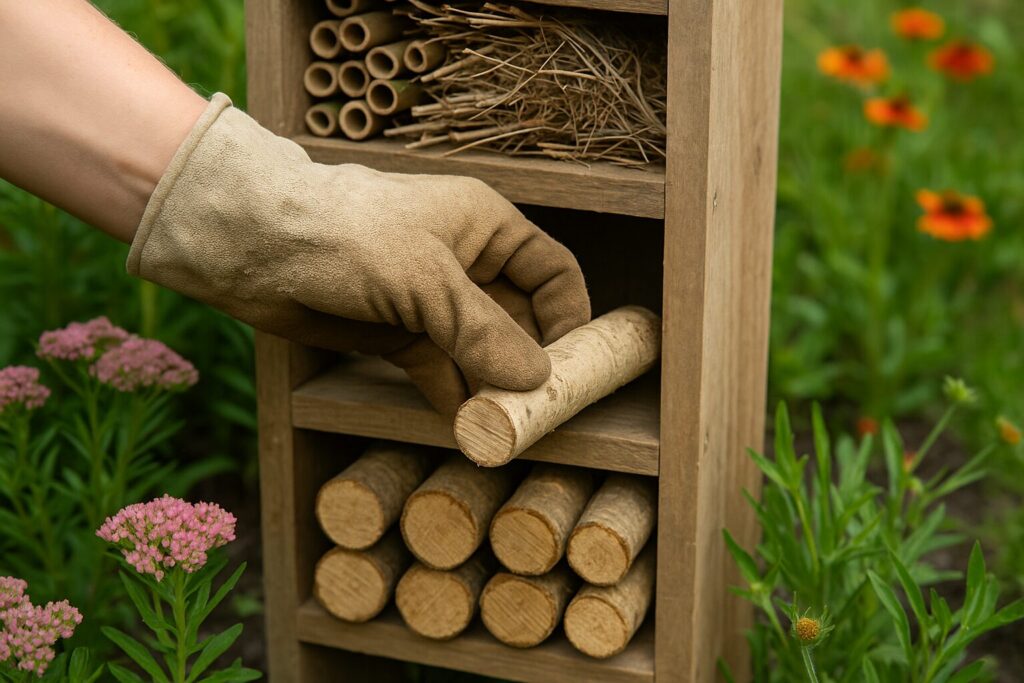
In concert with flower selection, we engineer ground-nesting and nesting refugia. Many native bees require bare, well-drained soil to nest so we maintain patches free of turf or mulch and delay early spring cleanup to preserve dormant stems, leaf litter, and brush piles that serve as overwintering sites for butterflies, bees, and beneficial insects. We design insect hotels and deadwood features like vertical bundles of hollow stems, drilled logs, or brush shelters that accommodate solitary bees, wasps, ladybirds, moths, and ground dwellers. Tube diameters range from approximately. 2–10 mm to meet specific bee species’ nesting needs, while the tilt and drainage design avoids waterlogging.
Ground beetles are among the most important allies in maintaining garden balance, especially in organic landscapes. These nocturnal predators actively feed on slugs, caterpillars, root maggots, and weed seeds, often patrolling soil surfaces and leaf litter under the cover of darkness. To support them, we incorporate ground-level refuges with coarse organic mulch, native grass clumps, and uncut perimeter edges that retain moisture and cover.
Our design strategy includes beetle banks, raised linear mounds with dense bunch grasses such as tufted hairgrass and red fescue, providing beetles a stable overwintering habitat and warm microclimates for breeding. We avoid tilling, which destroys beetle nests, and instead use no-dig practices that preserve soil structure. Rock piles, bark slabs, and deadwood edges are also placed in shaded garden borders to offer cool, dark shelter during dry summer days. By maintaining structural diversity at soil level, we create dependable shelter and hunting grounds that allow beetle populations to stabilize and thrive across seasons.
Ladybugs and green lacewings are two of the most effective biological control agents in pollinator-supportive landscapes. While adult ladybugs feed on nectar and pollen, their larvae consume vast quantities of aphids, scale insects, and mealybugs. Lacewing larvae—often called “aphid lions” are similarly voracious predators. Our goal is to provide both food sources and habitat continuity for these beneficials through thoughtful plantings and shelter zones.
We use a mix of flat umbel flowers such as dill, fennel, Queen Anne’s lace, and golden alexander, which provide accessible nectar for adults. Interspersed shrubs like elderberry, spirea, and viburnum serve as protective egg-laying zones, while dense herbaceous borders offer cover for developing larvae. We also leave some areas with mild plant stress or pest presence (in early spring), since populations of aphids serve as essential food for lacewing larvae during initial emergence. Brush piles and straw bundles placed near flowering strips further enhance overwintering conditions. These design elements help sustain the full life cycle of ladybugs and lacewings without disrupting their population balance with synthetic pesticides or frequent mechanical disturbance.
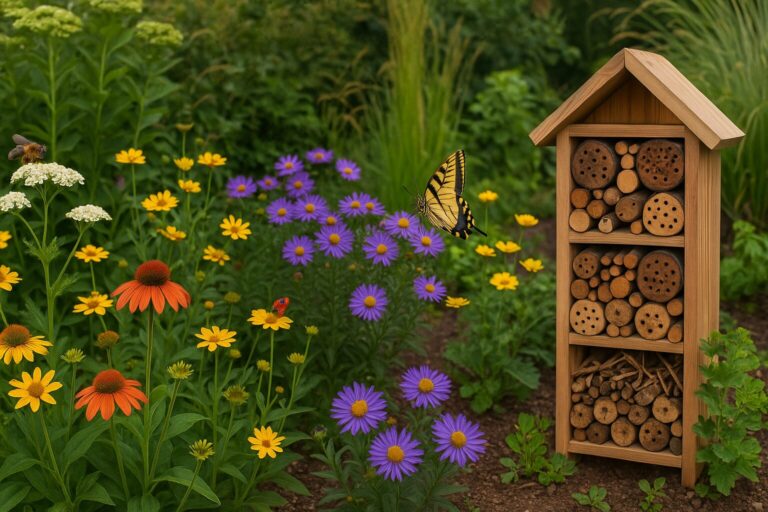
Rather than isolated garden patches, we emphasize pollinator corridors, strategically placed native wildflower strips or hedgerows that bridge green spaces across properties, linking yards to municipal pollinator gardens and nearby parks. These corridors enable insects to move, forage, and reproduce across fragmented urban landscapes, enhancing genetic diversity and species resilience.
We layer vegetation both horizontally and vertically: low-growing groundcovers and herbaceous forbs adjacent to taller perennials, shrubs, and small trees, ensuring structural diversity that supports different insect guilds. Beetle banks—raised strips planted with bunch grasses and nectarous broadleaf perennials like Vicia faba, centaurea, and borage offer habitat for predatory insects while creating visual screening and erosion control.
As part of ecosystem restoration, we champion companion planting: integrating nitrogen-fixing clovers under shrubs or herbs like mint, basil, and marigold near vegetables to attract predatory hoverflies, lacewings, and parasitic wasps that prey on aphids and caterpillars—supporting pest control via ecological balance, not chemical inputs. We also recommend allowing lawn flowers like clover and dandelions to bloom by mowing less frequently, which provides supplementary forage to native bees.
Organic maintenance underpins all our designs. We avoid synthetic pesticides entirely, preferring manual weed control, mulches of native leaf litter, and targeted ecological practices. This avoids harming beneficial insects and preserves the diverse foraging and nesting resources they depend on. By restoring native plant communities, enhancing soil structure, and managing moisture with green infrastructure, we reduce erosion, support water retention, and enrich biodiversity at every scale.
Our designs may include:
We design not only for momentary visual appeal, but for long-term ecological function through adaptive maintenance. Habitat assessment tools help monitor species presence, floral abundance, nesting activity, and pest-control balance. Maintenance cycles include seasonal refresh of nesting materials, planting overwintering hosts, and rotational thinning of shrubs to avoid shading out herbaceous habitat pockets.
By combining native plant succession planning, fine-scale structural habitat, predator-prey ecological timing, pollinator corridor connectivity, and pesticide-free practices, a landscape can become more than just attractive, it can become a stable, high-functioning habitat that supports a thriving population of beneficial insects. These landscapes not only reduce reliance on chemical intervention but also play a direct role in restoring ecosystem health across Seattle’s urban and suburban neighborhoods.
Our beneficial insect habitat services are designed to bring ecological function and beauty together in your Seattle landscape. Whether you’re interested in encouraging native bees, supporting predatory beetles, or creating overwintering spaces for lacewings and ladybugs, we offer expert guidance and hands-on design support to help your garden thrive naturally. From small urban yards to large restoration sites, we tailor every habitat to your site’s unique soil profile, plant palette, and seasonal dynamics.
If you’re ready to take the next step in building a resilient, pollinator-rich garden, reach out to Rutheo Designs. Email us at connect@rutheodesigns.com or call (360) 844-2989. We’re happy to answer questions about insect hotels, wildflower corridors, habitat layering, or any aspect of ecological garden design.
We use cookies to improve your experience on our site. By using our site, you consent to cookies.
Manage your cookie preferences below:
Essential cookies enable basic functions and are necessary for the proper function of the website.
Google Tag Manager simplifies the management of marketing tags on your website without code changes.
Statistics cookies collect information anonymously. This information helps us understand how visitors use our website.
Google Analytics is a powerful tool that tracks and analyzes website traffic for informed marketing decisions.
Service URL: policies.google.com (opens in a new window)
Google reCAPTCHA helps protect websites from spam and abuse by verifying user interactions through challenges.
Marketing cookies are used to follow visitors to websites. The intention is to show ads that are relevant and engaging to the individual user.
Facebook Pixel is a web analytics service that tracks and reports website traffic.
Service URL: www.facebook.com (opens in a new window)
You can find more information in our Cookie Policy and Privacy Policy.