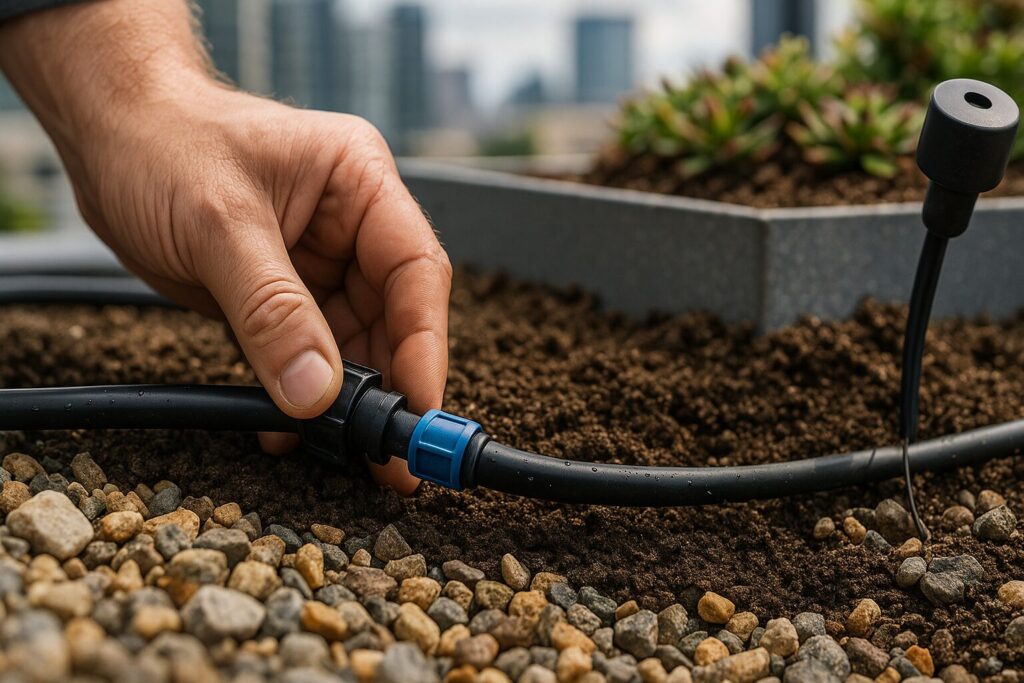
Moving from rooftop garden planning and design to installation requires dependable delivery systems. We handle the operational setup for Seattle rooftop gardens, coordinating drainage, substrate, irrigation, and wind and shade response. Through regular monitoring and ongoing maintenance, we support healthy plant environments through wet winters, dry summers, and variable rooftop conditions.
At Rutheo Designs, we tailor every irrigation system to the unique needs of your rooftop garden. Our focus is on delivering water precisely where it’s needed, conserving resources and promoting healthy growth. With cutting‐edge technology and sustainable practices, we ensure your plants thrive through Seattle’s wet winters and dry summers.
We design precision drip and micro-spray layouts that deliver water directly to plant root zones, reducing surface evaporation and limiting runoff. Our systems use pressure-compensating emitters and adjustable micro-spray nozzles, enabling fine-tuned flow rates for diverse planting areas. By creating separate watering zones for shallow-rooted sedums and deeper perennials, we ensure each species receives the optimal moisture level. Flexible polyethylene tubing is routed discreetly beneath the substrate, and all fittings are rated for UV resistance and freeze tolerance to withstand Seattle’s climate swings.
To decrease reliance on municipal supply, we link rooftop gutters and surface drains into a first-flush diverter and sediment filter, channeling clean rainwater into above-roof cisterns or underground tanks. An automatic switch-over valve directs harvested water into the drip network when storage levels exceed a set threshold. This rain-fed approach typically offsets 30–50% of seasonal irrigation needs, cutting utility costs while supporting sustainable water management.
In high-traffic or seating areas, we install low-profile capillary mats beneath paver slabs or gravel paths. These mats draw moisture upward into potted specimens or planter pockets through capillary action, ensuring even wetting without visible tubing. Subsurface drip laterals can also be embedded directly in the substrate layer, maintaining an uncluttered aesthetic and protecting irrigation components from UV exposure.
Our systems leverage soil moisture sensors and weather-adaptive controllers to automate run schedules and prevent overwatering. Sensors placed at varying depths report volumetric moisture content, allowing controllers to adjust irrigation duration and frequency in real time. By integrating local weather forecasts, the controller can skip cycles during heavy rainfall or delay watering ahead of predicted storms. A user-friendly smartphone app lets you monitor system status, view water-use metrics, and manually override schedules for special events or plant demonstrations.
Our engineered substrates blend expanded clay aggregate, perlite, and aged organic compost to create a lightweight growing medium that balances moisture retention with air porosity, significantly reducing rooftop load compared to traditional topsoil. We pair this media with a high-capacity drainage mat and nonwoven geotextile filter to channel excess water quickly into roof outlets, preventing waterlogging and protecting underlying membranes from root intrusion. By carefully calibrating particle sizes and filtration thresholds, we ensure hydraulic conductivity remains consistent over years of wet winters and dry summers, supporting vigorous root systems without risking clogging or compaction.
To maintain long-term fertility in a lightweight profile, we integrate slow-release organic granules and biochar into the substrate, boosting cation exchange capacity and fostering beneficial microbial communities. Our routine substrate testing—measuring pH, electrical conductivity, and organic matter content—guides targeted supplement applications, such as mycorrhizal inoculants or compost teas, to sustain nutrient cycling and plant resilience. This holistic approach allows us to minimize fertilizer inputs, reduce irrigation demand, and deliver a stable, breathable foundation that supports diverse plant palettes and maximizes both ecological function and visual appeal on your rooftop.
Our remote monitoring tools deploy IoT-connected sensors to track substrate moisture, air temperature, and light levels across multiple zones. Data streams into a secure cloud dashboard, where we analyze trends in water use, thermal performance, and plant health. Alerts notify us if moisture drops below optimal thresholds or if unexpected temperature swings occur, allowing us to adjust irrigation schedules or recommend targeted interventions before stress symptoms appear. You can also access the dashboard to view live metrics, receive maintenance reminders, and approve any recommended system overrides from your smartphone or desktop.
Complementing our digital oversight, our seasonal maintenance plans include quarterly on-site inspections and hands-on care. In spring, we refresh surface mulches, remove debris, and aerate compacted substrate layers to rejuvenate root zones. Summer visits focus on pruning, pest scouting, and verifying irrigation output per emitter to catch clogs early. Come fall, we winterize irrigation lines, flush filters, and secure windbreaks, while testing drainage outlets to prevent ice blockages. Each year, we collect substrate samples for lab analysis—measuring pH, electrical conductivity, and organic matter to tailor nutrient amendments like slow-release granules or mycorrhizal inoculants. Our integrated approach keeps your rooftop garden resilient, efficient, and visually vibrant from first frost to peak bloom.
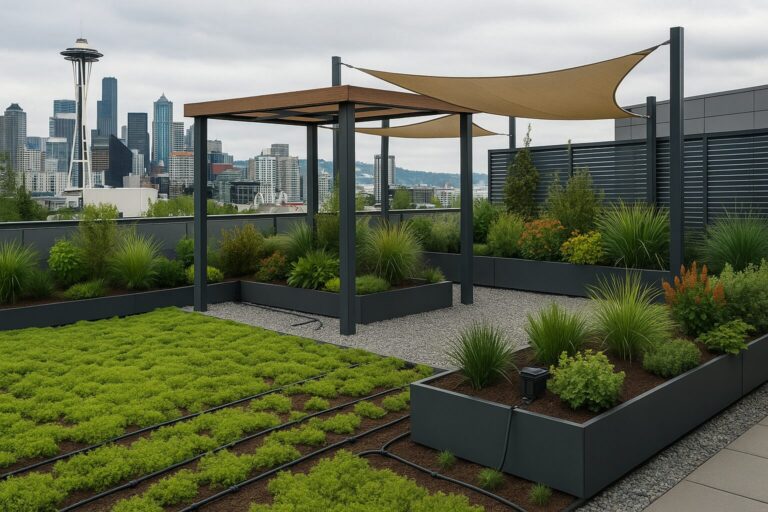
We combine engineered barriers with living elements to shield rooftop plantings from harsh winds and provide adaptive shade. By clustering hardscape structures and vegetation strategically, we deliver reliable protection and seasonal comfort without sacrificing aesthetics or views.
Our custom-designed panels mount along roof perimeters, with perforations calibrated to reduce wind speeds by up to 50% while maintaining airflow. Made from lightweight, UV-resistant aluminum or stainless steel, they anchor with minimal ballast and feature a powder-coat finish for long-term durability.
We select hardy evergreens—such as dwarf hemlock, coastal yew, and boxwood—to serve as living wind filters. Planted in reinforced lightweight planters, these shrubs create gradual wind gradients, trapping debris and cushioning air currents before they reach delicate sedum mats or perennials.
Our steel-framed pergolas use tensioned, UV-resistant fabric sails that extend or retract with simple pulley systems. When closed, the canopies block prevailing winds; when open, they admit breezes and sun. Climbing vines like hardy clematis can later soften the structure and add seasonal color.
For flexible coverage, we install shade sails anchored to rooftop pylons or building supports. The triangular or custom-shaped sails buffer wind and cast dappled light patterns, creating cooler pockets over seating and planting zones without obstructing sightlines.
In larger planters, we position fast-growing trees, such as Japanese maple and serviceberry with guying systems that secure trunks against gusts. Their branching canopies offer filtered shade for understory plantings and seating areas, while the trunk silhouettes break wind currents to protect the overall garden.
Once a plan is established, rooftop delivery systems must be calibrated to site conditions and rooftop exposure. Intense sunlight, shifting wind, and seasonal precipitation require coordinated drainage, proper substrate depth, and targeted irrigation. Ongoing monitoring and attentive maintenance allow delivery systems and wind and shade response measures to be adjusted as site conditions evolve over time.
We use interlocking fiberglass and recycled-plastic planters to create adaptable planting zones that can be reconfigured as design needs evolve. These modules simplify installation and allow for seamless integration of irrigation and drainage components. They also facilitate access for roof maintenance and enable seasonal swaps of plant palettes without disrupting the overall layout.
Drawing on patterns found in natural ecosystems, we arrange planting beds, pathways, and seating areas in flowing curves and clustered groupings. This approach encourages movement through the space and supports diverse microhabitats from moist shade pockets under ferns to sun-drenched sedum islands, enhancing both ecological function and sensory engagement.
To provide year-round interest, we layer foliage by form and hue—combining the fine blades of carex grasses with the broad leaves of hostas, and accenting with silver-gray artemisia or purple-leaved heuchera. Seasonal bloomers like kinnikinnick and Oregon iris punctuate the scheme with pops of color, while evergreen accents maintain structure during winter months.
We provide bespoke rooftop garden services to help you create and maintain vibrant, sustainable landscapes atop your Seattle building. Our expert team specializes in irrigation system installation, lightweight soil and drainage solutions, wind protection and shade structures, integrated maintenance and monitoring, and thoughtful design and aesthetics. Through an initial consultation, we evaluate your roof’s structural capacity, sun and wind exposure, and hydrologic needs to develop a tailored plan that maximizes plant health, conserves resources, and enhances urban biodiversity.
Ready to elevate your rooftop into a flourishing retreat? Email us at connect@rutheodesigns.com or call (360) 844-2989 to schedule your consultation. Whether you’re curious about drip irrigation layouts, engineered substrates, windbreak systems, sensor-driven maintenance, or modular planter designs, we’re here to guide you every step of the way.
We use cookies to improve your experience on our site. By using our site, you consent to cookies.
Manage your cookie preferences below:
Essential cookies enable basic functions and are necessary for the proper function of the website.
Google Tag Manager simplifies the management of marketing tags on your website without code changes.
Statistics cookies collect information anonymously. This information helps us understand how visitors use our website.
Google Analytics is a powerful tool that tracks and analyzes website traffic for informed marketing decisions.
Service URL: policies.google.com (opens in a new window)
Google reCAPTCHA helps protect websites from spam and abuse by verifying user interactions through challenges.
Marketing cookies are used to follow visitors to websites. The intention is to show ads that are relevant and engaging to the individual user.
Facebook Pixel is a web analytics service that tracks and reports website traffic.
Service URL: www.facebook.com (opens in a new window)
You can find more information in our Cookie Policy and Privacy Policy.