Backyard pond plans often start with shape and the view from the house. In a Seattle yard, we start one step earlier: can the homeowner see and reach the water through leaf drop, winter rain, and a summer dry spell? The answer affects where the pond sits and how its edge is built.
At Rutheo Designs, we test those relationships while the proposed waterline is still a hose on the ground. A broad planting shelf changes the edge. Dense rushes can hide the waterline, and a low spot that seems convenient may also collect runoff or leave stormwater with nowhere useful to go. Mosquito monitoring, household safety, planting access, overflow, and summer water loss all meet at the same small piece of ground, so the pond has to work there in every season.
Choose a Location You Can Inspect in Every Season
A shady corner beneath deciduous trees can look ideal in July. The canopy softens the afternoon sun, and the water remains visible from the patio. By October, leaves may be dropping faster than the homeowner can lift them out, especially when a fence or dense shrubs block most of the edge.
That autumn problem changes how we place the pond in summer. We mark the waterline with a garden hose, then walk around it carrying the net and bucket that will be used later. There should be room to thin plants, clear windblown debris, and check the water after rain or during a dry spell. Reaching the pond from one cramped or slippery point isn’t enough.
We also follow what could enter the footprint. Penn State Extension advises keeping backyard ponds away from runoff that may carry lawn or road contaminants. Roof flow and uphill drainage deserve the same attention before digging because a low corner may collect more than rain falling directly on the pond.
If the planted edge, working access, and storm route cannot share the proposed footprint, we move the hose. Adjusting the location at this stage is far easier than trying to reach across a liner and established plants later.
Treat Wildlife Access and Child Access as Separate Decisions
Shallow shelves can hold emergent plants and give birds access to water. A gradual slope can help amphibians move between the pond and damp cover nearby; rocks or a partly submerged log may add resting places. We shape those features for wildlife, but none of them keeps a child from reaching the water.
If a young child regularly visits a home with a pond beyond the patio, we walk the route from the back door, check which doors and gates open toward the yard, and look at where adults usually sit or work. A sloped bank does not change how easily the child can approach the pond.
Seattle Children’s treats garden ponds as a drowning hazard and recommends fencing them off when young children may be present. The family still has to decide how supervision and barriers will work at this home, including during a gathering when routines change. We also ask the homeowner to check current local rules and speak with their insurer before construction; the wildlife edge cannot answer those questions.
Pumps, lights, or receptacles near the water add an electrical decision. An appropriate electrician should review the equipment, fittings, wiring route, and installation rather than leaving those details inside the planting plan. Until household access and electrical work are resolved, the pond location is not settled.
Plan for Mosquitoes Without Counting on a Guarantee
Mosquito work starts outside the pond. After rain, a plant saucer, folded tarp, open bucket, wheelbarrow, or clogged gutter may hold water that is easier to miss. We walk the surrounding yard, empty movable containers, and correct the way stored items collect rain. The Washington State Department of Health recommends reducing this standing-water habitat around homes.
The pond still needs direct observation. We look across the surface and along sheltered edges for larvae rather than assuming that aquatic plants, moving water, dragonflies, or other predators have taken care of mosquitoes. Those elements may suit the pond, but their presence doesn’t tell us whether larvae are there.
Stocking nonnative fish is a poor shortcut. Oregon State University Extension warns that fish released for mosquito control can consume amphibians and aquatic invertebrates, and flooding may let them escape a backyard water feature. They also change what the pond supports and how it must be maintained.
Some residential Bti products are available in Washington, though the use boundary is narrow. The Department of Health says to follow the product label and apply only to water that will not drain off the property, such as an ornamental pond or another closed system. If the water connects to or could reach state surface waters, only a licensed pesticide applicator may apply Bti, and the property owner or applicator will likely need an NPDES permit. For a pond with that connection, we refer the treatment question out instead of guessing.
Give Winter Overflow a Visible Route Before the Pond Fills
A pond beside a south-facing patio may look settled during an August dry spell. In winter, the same basin can receive sustained rain and perhaps runoff from a nearby roof. Once it fills, water needs a route that doesn’t cross the patio path or return toward the house.
We trace that route before treating roof runoff as a pond source. When possible, a steady rain shows us more than a dry-day sketch: we can mark the full-water edge, follow the existing grade beyond it, and see where doors, shared fence lines, low beds, or steep ground interrupt the route. Stakes keep the proposed path visible while the pond and planting are laid out.
Seattle Public Utilities advises property owners to direct private drainage away from foundations, avoid sending it onto neighboring property or over a steep hill, and create storm flow paths that will not damage a neighbor’s property. If the route reaches an uncertain drainage connection, we stop there and resolve the discharge question with the appropriate City department.
Roof water and overflow belong on the same drawing. Moving a downspout toward the pond adds winter inflow but doesn’t show where the water goes after the pond is full. A rain garden holds stormwater temporarily; a wildlife pond keeps standing water. Sending roof runoff toward either feature still requires a route for excess water.
If the marked path ends in an untested corner, we move the pond or keep roof water separate before digging.
Build the Planting Around Habitat and Maintenance Access
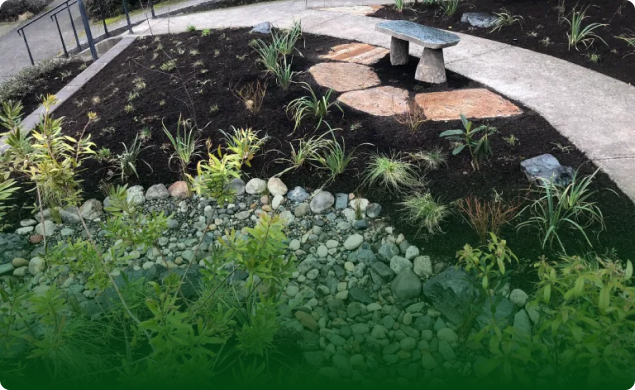
The pond edge has to remain legible as it grows in. Shallow shelves can hold emergent plants, while nearby vegetation offers cover between the water and the rest of the garden. We also leave some open water and at least one approach where the homeowner can kneel, use a net, or reach plants that need thinning.
Under deciduous trees, a solid ring of rushes may look full in summer, then trap fallen leaves where they are hard to lift out. Mature spread matters as much as planting-day spacing. Our aquatic plant selection and installation work accounts for that growth so access does not disappear behind the plants.
Emergent plants will still need thinning, and windblown leaves will still need removing. Dense growth may also hide the waterline or visible equipment just when a change needs attention. A fixed stone or discreet marker at the open edge gives the homeowner a consistent place to look without turning the pond into a measuring project.
By August, that clear edge does another job: it shows how the pond is responding to dry weather before the plants obscure the view.
Make a Summer Water-Loss Plan Before August
Summer evaporation can lower a pond’s water level. A fixed marker shows what happens through an August dry spell and again after rain.
We keep a simple record of the waterline along with warm or windy weather, rainfall, water additions, debris removal, and recent work on a pump or fountain when one is present. A single reading cannot tell us that the pond is leaking, and a top-off calendar borrowed from another pond cannot explain why this one changed. The record gives us a pattern to compare.
Access affects the response. The intended water source should reach the pond without blocking the main path or crushing the plants beside the observation edge. While water is added, the homeowner should be able to watch the level and inspect visible equipment. When a change does not fit the recent record, we review what happened around the pond and decide whether a pond professional should investigate further.
In our wildlife habitat gardening work, the pond remains part of a yard that people can observe and care for through the seasons.
A wildlife pond is ready to move ahead when the homeowner can explain how it will be watched and cared for on this property. Sometimes that confirms the chosen location. Sometimes the pond should move, become simpler, or wait until an unresolved site condition is understood.
For a Seattle yard still at that decision point, our wildlife pond creation work is where we test the proposed footprint against the way the property is actually used.