RainWise can be a strong opportunity for Seattle homeowners, but it is not the same thing as simply deciding you want a rain garden or buying a cistern. The program is tied to eligibility, roof runoff, installation requirements, inspection, and the way water moves through your property. Before design begins, check whether your site is ready for the project.
That early check matters because RainWise projects usually begin at the downspout, not in the planting bed. A rain garden may look like the visible feature, and a cistern may look like the main object, but both manage roof water. If the roof area, downspout location, overflow route, or yard grade does not fit, the project may need a different layout.
This article covers what to check before planning a RainWise rain garden or cistern. It is not a replacement for official eligibility review or contractor guidance. If you are comparing stormwater approaches, read rain garden design in Seattle, French drain or rain garden?, and Rutheo’s RainWise installations page.
Confirm whether the property and project type may fit
The first check is program fit. RainWise is intended for eligible properties and qualifying rain garden or cistern work. Eligibility can depend on the drainage basin and current program rules, so verify the address before treating a rebate as certain.
You do not need the full design on day one. You should avoid building the project around assumptions such as:
- every Seattle address qualifies
- every roof face can be counted the same way
- every cistern or rain garden layout will meet requirements
- any contractor can complete rebate-eligible work
- a rebate will cover a project that was already built outside the process
Those assumptions can create expensive disappointment. Treat RainWise as a guided stormwater pathway with requirements, not a generic discount on landscape work.
Even if the property does not fit the rebate program, the same site-reading work is still useful. Downspout routing, roof runoff, and soggy lawn edges matter whether or not a rebate applies.
Map the downspouts before choosing the feature
RainWise planning starts with where roof water leaves the house. Walk the property during or soon after rain and note each downspout. Where does it discharge now? Does it connect to a pipe? Does it spill onto a splash block? Does it disappear underground? Does water run across a path, into a lawn edge, or toward a neighbor?
Useful downspout notes include:
- which roof plane each downspout appears to serve
- whether the discharge is visible or piped
- how close the downspout is to a foundation, path, patio, or slope
- whether water already causes erosion or saturation nearby
- where a cistern or rain garden could receive water without blocking circulation
This step often changes the project idea. A homeowner may want a rain garden in the sunny front yard, but the best roof area may discharge on the shaded side of the house. Another may want a cistern beside the back steps, but the overflow route may be too close to a path.
The downspout is not a minor plumbing detail. It is the starting point for the whole project.
Estimate roof area without overdesigning too early
RainWise projects are connected to rooftop rainwater, so roof area matters. You do not need a technical calculation before reaching out for guidance, but you should understand which part of the roof you hope to manage. A small porch roof, a broad main roof plane, and a detached garage roof can lead to different cistern or rain garden sizing conversations.
Look for:
- roof sections that drain to a single downspout
- roof planes that are easy to access from the yard
- gutters that are clogged, undersized, or poorly sloped
- downspouts that combine multiple roof areas
- places where a project would interfere with doors, windows, utilities, or service access
Notice whether gutter work is needed before stormwater work. A rain garden cannot perform well if the gutter overflows in the wrong place during heavy rain. A cistern cannot be used well if the inflow is clogged with debris.
Decide whether storage or infiltration fits the yard better
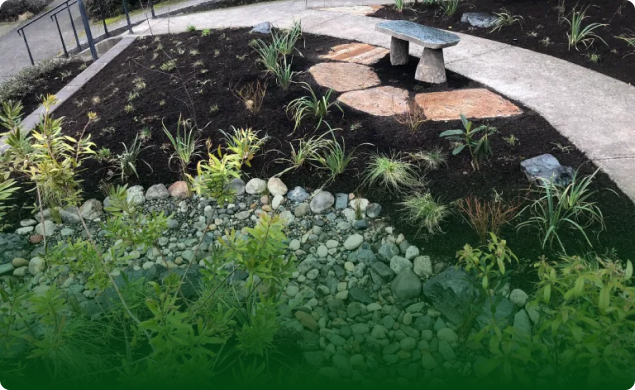
Rain gardens and cisterns solve the roof-water problem in different ways. A rain garden receives water, slows it, and helps it soak into the soil through a planted basin. A cistern stores roof water for later use and needs a planned overflow path when it fills. Some properties may fit one better than the other. Some may be candidates for both.
A cistern may be appealing when:
- there is a good downspout location near a stable pad
- stored water can be useful for summer irrigation
- the yard has limited room for a planted basin
- the homeowner wants a more compact stormwater feature
A rain garden may be appealing when:
- there is enough room for a basin and safe grading
- the yard would benefit from habitat-focused planting
- runoff can be directed away from structures and high-use paths
- the homeowner wants stormwater work to feel like part of the garden
The best answer may not be the one that first sounds more attractive. A cistern still needs overflow. A rain garden still needs siting, soil evaluation, and maintenance. The physical yard should guide the choice.
Trace the overflow route before committing
Overflow is one of the most important details homeowners miss. A cistern fills. A rain garden can receive more water than expected during a storm. If the project has no clear overflow route, it may create a new wet spot while solving the old one.
Before planning, ask:
- Where will water go when the cistern is full?
- Where will excess water move during a heavy storm?
- Will overflow cross a path, patio, stair, or driveway?
- Could water move toward the foundation or a neighbor’s property?
- Is there a lower planting area that can receive occasional water safely?
This is where RainWise planning overlaps with full-site drainage. The project should fit the grade, circulation, planting areas, and maintenance needs around it.
If the yard already has a soggy lawn edge or water crossing a walkway, pause before assuming a RainWise feature will automatically fix it. The project may help, but the existing drainage pattern still needs to be understood.
Check the soggy spots and compacted areas honestly
A wet lawn edge can be a clue, but it is not always the right place for a rain garden. Sometimes the spot is wet because soil is compacted from foot traffic. Sometimes roof water is collecting there. Sometimes a buried pipe or grade change is influencing the area. Sometimes shade keeps the soil damp long after the rain stops.
Before planning a rain garden, notice:
- whether water ponds briefly or lingers for days
- whether the area receives roof runoff or only surface runoff
- whether nearby soil is compacted or root-filled
- whether the spot is too close to a foundation
- whether the area is part of a daily walking route
This keeps the RainWise conversation distinct from generic “wet spot” problem-solving. A rain garden is a designed stormwater feature, not a way to decorate a failing low point. If water behavior is unclear, soil preparation for Seattle planting projects can help separate soil issues from drainage issues.
Think about maintenance before the project is approved
RainWise features are not meant to be ignored after installation. Cisterns need seasonal attention, debris control, and overflow awareness. Rain gardens need plant establishment, weeding, mulch care, sediment checks, and occasional adjustment as plants mature.
That maintenance does not have to be overwhelming, but it should be accepted up front:
- Who will check the cistern after storms?
- Who will keep gutters and screens clear?
- Who will weed the rain garden during establishment?
- Can the planting be maintained without stepping into the basin constantly?
- Will the feature still be accessible after shrubs mature?
Design can make maintenance easier. Clear access, visible overflow paths, and planting that fits the site all reduce friction. For homeowners who want support beyond installation, organic gardening services in Seattle can help frame practical ecological care.
Coordinate RainWise with the rest of the landscape
RainWise projects often touch more of the yard than homeowners expect. A cistern affects access, aesthetics, hose use, and overflow. A rain garden affects planting composition, path layout, mulch, grading, and sometimes lawn reduction. If the yard is already due for redesign, coordinate the stormwater feature with the broader plan.
Coordination matters when:
- a path may need to shift around a rain garden edge
- a patio drains toward the proposed project area
- a lawn replacement project could free up better stormwater space
- native planting or pollinator goals should connect to the rain garden
- irrigation planning could use stored cistern water
This is where RainWise can support an ecological landscape rather than sit off to the side as a utility feature. Sustainable landscape design in Seattle and native plant landscaping in Seattle can help connect the stormwater work to the rest of the garden.
When to bring in help
Bring in help when the project involves multiple downspouts, tight side yards, unclear underground piping, steep grade, large roof areas, or existing drainage problems. These conditions do not rule out RainWise, but they make early planning more important.
Professional guidance is also useful when the project should look integrated, not like an add-on. A rain garden should have a clear edge, plant structure, and access. A cistern should sit where it can be used and maintained without dominating the yard.
For early planning, garden coaching can help you organize questions before choosing a path. For site-specific water movement, an on-site consultation is often the stronger first step.
FAQ
Does every Seattle home qualify for RainWise?
No. Homeowners should check current eligibility through the official RainWise process before assuming a rebate applies. Property location and project requirements matter.
Should I choose a rain garden or a cistern first?
Start with the downspout, roof area, available space, and overflow route. Those site conditions usually make the better option clearer.
Can RainWise fix a soggy lawn?
Sometimes it can help with roof runoff, but a soggy lawn may also involve compaction, shade, soil structure, or grade. Diagnose the water source before treating RainWise as the full fix.
Where should a cistern overflow go?
Overflow needs a safe route away from foundations, high-use paths, and neighboring properties. It should be planned before installation, not improvised after the cistern fills.
Can a RainWise rain garden still look like part of a designed yard?
Yes. With thoughtful grading, edging, and planting, a rain garden can look intentional while managing roof runoff and supporting habitat value.
If you are considering RainWise in Seattle, schedule a consultation with Rutheo Designs. We can help you read downspouts, roof runoff, overflow routes, and garden fit before you commit to a rain garden or cistern plan.